For decades, suction-side pool cleaners have been the default choice for homeowners who want a relatively simple way to keep their pools free of debris. They connect to the existing filtration system, roam the pool floor while the pump runs, and quietly go about their routine, at least in theory. Yet the rise of cordless robotic pool cleaners has introduced a serious alternative. With self-contained filtration, programmable cleaning modes, and wall-climbing capabilities, these robots promise more than incremental improvement. They suggest a fundamental shift in how pools are maintained.
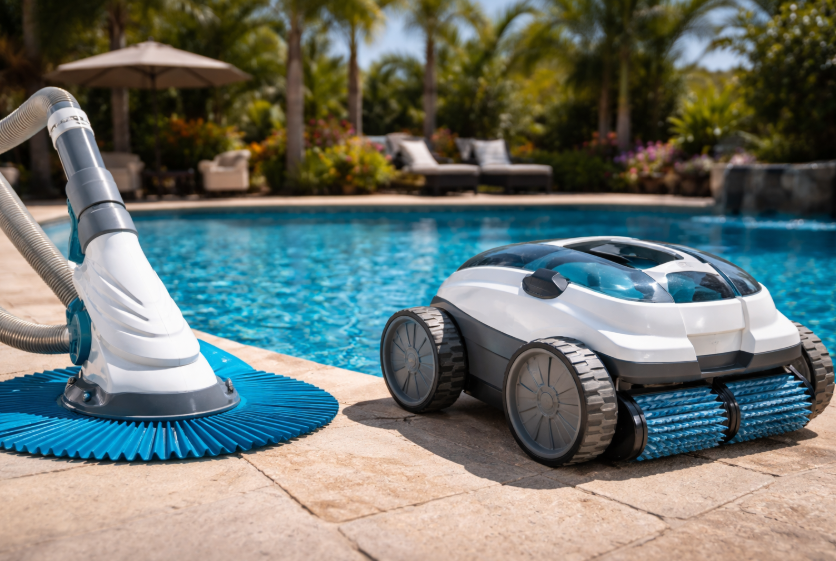
To understand whether that shift is justified, it helps to compare a long-running suction-side cleaner like the Kreepy Krauly with a modern cordless robot such as the Aiper Scuba S1 Pro. The contrast reveals not only differences in performance, but also in convenience, maintenance routines, swimming experience, and long-term value.
The Cleaner Challenge: A Real-World Test
Any comparison between cleaning systems needs to reflect everyday conditions rather than laboratory perfection. In this case, the pool under our review is 25 years old, with visible discoloration due to age and an imperfect plaster job. The water itself remains crystal clear, but the environment introduces a familiar challenge: windblown debris.
In regions where strong winds are common, a single day can leave the pool scattered with leaves, dust, and fine particles. That scenario creates a practical test bed. The question is not whether a cleaner works under ideal circumstances, but how it performs when the pool looks visibly dirty before the cycle begins.
With that context, the matchup unfolds across four areas: setup, cleaning ability, weekly maintenance, and swimming experience. Each category exposes trade-offs that go beyond marketing claims.
Round One: Setup and First Impressions
Setup is often underestimated, yet it sets the tone for long-term satisfaction. A cleaner that is complicated to install or adjust can quickly erode the appeal of ownership.
The Aiper Scuba S1 Pro arrives in a box with a dry weight of 38 pounds. Out of the box, the unit itself weighs just over 27 pounds, which makes handling more manageable than initial packaging suggests. Preparing it for use involves:
- Charging the battery
- Removing protective plastic
- Reviewing the manual to select the appropriate cleaning mode
- Placing the unit into the pool
There is also a companion app, primarily used to check battery charge and switch modes. The interface is straightforward and not overloaded with unnecessary features. For most users, the time spent learning the controls is minimal. In practical terms, excluding charging time, setup is quick and intuitive.
By contrast, assembling the Kreepy Krauly requires attaching the pleated skirt, foot pad, and bumper. These components fit tightly and can be frustrating to install. After assembly, the hose sections must be connected and sized correctly. Once placed in the pool, the system depends on the pool pump. Fine-tuning is often required to achieve a proper cleaning pattern.
The Kreepy Krauly typically takes about 30 minutes to install and adjust. Although its lighter body makes it easy to drop into the pool, the overall process demands more fiddling.
In this category, the robotic cleaner holds a clear advantage. The ability to select a cleaning mode at the press of a button, without wrestling with hoses or adjusting flow rates, reduces friction from the start.
Round Two: Cleaning Performance and Coverage
Cleaning ability is the core metric. Convenience is valuable, but it means little if debris remains behind.
The Aiper Scuba S1 Pro demonstrates aggressive suction and a structured debris management system. Debris is channeled toward a large suction port and directed into a primary basket through a flapper door. Finer particles that slip through are captured by a secondary filter. The combination of extra-large suction port, aggressive rollers, and an advertised 100 gallons per minute flow rate translates into visible power.
The unit offers four cleaning modes:
- Floor and walls
- Floor only
- Waterline
- Eco mode
Eco mode runs for about 45 minutes and can be left in the pool for up to a week. It is designed to run three times before exhausting its battery. In floor and wall mode, the robot cleaned the pool in a little over an hour.
Two aspects stand out.
First, wall climbing. The Aiper Scuba S1 Pro climbs vertical surfaces and actively scrubs them. It also reaches most pool steps, repeatedly attempting to mount even the top step. This persistence indicates a navigation algorithm that is not easily deterred by obstacles.
Second, waterline cleaning. According to Aiper, the waterline feature is the first of its kind in the industry. Waterline grime often accumulates where oils, sunscreen, and organic matter meet the air. Traditional suction-side cleaners rarely address this area directly.
The Kreepy Krauly, on the other hand, excels in steady, long-duration operation. Because it runs whenever the pump is active, it may operate up to 12 hours a day. It does not necessarily remove everything on the first pass, but over time it covers the floor repeatedly. Eventually, most debris is collected.
However, limitations become apparent:
- It does not clean the waterline.
- It does not clean stairs.
- It can become temporarily stuck in repetitive patterns.
- Its performance is tied to pump operation.
In direct head-to-head comparison, the robotic cleaner delivers faster, more comprehensive coverage. The suction-side unit compensates with endurance and a set-it-and-forget-it nature. Yet in terms of thoroughness, particularly along walls and waterline, the robot clearly outperforms.
Round Three: Weekly Maintenance and Filter Handling
Owning a pool is as much about maintenance routines as it is about cleaning cycles. How often you need to intervene, empty baskets, or service filters influences long-term satisfaction.
The Aiper Scuba S1 Pro contains a 5-liter internal basket, roughly comparable in capacity to a main pump basket. It also includes a secondary filter. Both components can be removed and rinsed quickly with a hose. Because the robot is self-contained, cleaning its basket does not require stopping the pool pump.
The Kreepy Krauly relies on the pool’s main filtration system. Debris accumulates in the pump basket and ultimately in the pool’s primary filters. To clean the pump basket, the pump must be stopped and the lid removed. This interrupts circulation and adds procedural steps.
There is a plausible secondary effect worth noting. By capturing debris internally before it reaches the main filter system, the robotic cleaner may reduce the load on primary pool filters. Currently, the filters are cleaned about every three months. With a robot absorbing more debris upfront, it may be possible to extend that interval. Although long-term data is not yet available, the expectation is that main filter life could improve.
Still, this round is not one-sided. The robotic cleaner must be physically removed from the pool to:
- Empty the basket
- Rinse the filters
- Recharge the battery
The Kreepy Krauly, by contrast, remains in the water for extended periods without needing to be lifted out. If convenience is defined as minimal lifting, the suction-side cleaner scores a point.
Even so, when weighing ease of access to debris baskets and potential filter longevity, the robotic cleaner holds a narrow edge.
Round Four: Swimming Experience and Everyday Enjoyment
Beyond technical metrics lies a simpler question. How does each system affect the enjoyment of swimming?
Suction-side cleaners use hoses that snake across the pool. While functional, they can interfere with swimming and lounging. The Kreepy Krauly also produces a characteristic clacking sound during operation, which may be tolerable but is noticeable.
The Aiper Scuba S1 Pro, being cordless, eliminates hoses entirely. When not in use, it can be removed from the pool in under two hours. This flexibility transforms the swimming experience. The pool can be pristine and free of equipment when guests arrive.
From a user perspective, this difference is substantial:
- No hose to navigate around
- No continuous clacking noise
- No dependence on pump runtime
- Quick removal when the pool is in use
In this category, the robotic cleaner delivers a decisive advantage. The improvement is not incremental. It changes how the pool feels as a leisure space.
Comparing Pricing and Long-Term Costs
Cost often shapes the final decision. At first glance, the numbers appear straightforward.
The Kreepy Krauly costs around $500. However, recurring expenses include replacing the skirt, foot pad, and bumper every couple of years. These parts can cost between $50 and $100, depending on sourcing.
The Aiper Scuba S1 Pro is typically priced between $1,000 and $1,200. While it likely contains wear components that will eventually require replacement, long-term replacement frequency is not yet fully known.
The price gap is significant. The robotic cleaner costs roughly double the upfront investment. Yet evaluating value requires looking beyond sticker price.
Factors influencing total cost of ownership include:
- Reduced strain on main filters
- Possible extension of filter cleaning intervals
- Lower dependency on pump runtime for cleaning
- Improved cleaning speed and coverage
If the robot reduces pump usage dedicated to cleaning cycles, there may be indirect energy savings. However, without specific data, it is prudent to treat this as a possibility rather than a guarantee.
Ultimately, the decision hinges on how much the user values:
- Comprehensive wall and waterline cleaning
- Cordless convenience
- Reduced interference during swimming
- Faster cleaning cycles
For some, the suction-side cleaner remains adequate and cost-effective. For others, the added performance and convenience justify the premium.
A Shift in Philosophy: From Continuous Circulation to Targeted Cleaning
The deeper distinction between suction-side and robotic cleaners lies in philosophy.
Suction-side cleaners rely on continuous circulation. They operate as an extension of the pool’s filtration system. Cleaning is gradual and persistent. The system is simple and well understood.
Robotic cleaners represent targeted intervention. They are deployed, perform a defined cleaning mission, and are removed. They operate independently of the main filtration system. Their intelligence and design focus on maximizing coverage within a shorter timeframe.
This shift reflects broader trends in home automation. Devices are increasingly specialized, self-contained, and optimized for efficiency. Rather than relying on one large system to perform multiple tasks, smaller dedicated machines handle specific functions with greater precision.
In the case of the Aiper Scuba S1 Pro, that specialization translates into strong suction, structured debris handling, multi-mode programming, and advanced wall navigation.
Final Verdict: Is the Upgrade Worth It?
When comparing setup simplicity, cleaning coverage, maintenance handling, swimming comfort, and overall experience, the robotic cleaner consistently outperforms the suction-side alternative in most categories.
The Kreepy Krauly remains reliable. It benefits from continuous operation and lower upfront cost. For pool owners who prioritize simplicity and are comfortable with hoses and pump-dependent cleaning, it still fulfills its role.
However, the Aiper Scuba S1 Pro elevates the standard. It climbs walls, scrubs the waterline, tackles steps, and completes a full cleaning cycle in just over an hour. It removes the visual and physical clutter of hoses. It centralizes debris in an accessible basket. It introduces programmable modes and a straightforward app interface.
Would it be worth buying? For those seeking improved cleaning precision, reduced hassle during swim time, and a more modern maintenance routine, the answer leans strongly toward yes. The higher price reflects not just new hardware, but a different class of performance.
In the evolving landscape of home maintenance technology, robotic pool cleaners are no longer experimental luxuries. In cases like this, they appear to be the logical next step.