Smart home security does not always begin with complex cameras or advanced AI. Sometimes, it starts with something far simpler: a small device that quietly tells you whether a door, window, or drawer is open or closed. Contact sensors, once limited to traditional alarm systems, have evolved into flexible, wireless components that integrate deeply into modern home automation platforms.
This guide explores how contact sensors work, how they perform over years of real-world use, and which models stand out across different ecosystems. It also examines creative automation ideas that go beyond security, showing how these small devices can reshape daily routines in subtle but meaningful ways.
How Contact Sensors Work and Why They Still Matter
Contact sensors were originally built for wired alarm systems. Their operating principle remains elegantly simple. Each sensor consists of two components:
- A reed switch containing two slightly separated metal contacts
- A magnet that pulls those contacts together when placed nearby
When the magnet moves close enough, the metal contacts meet, completing a circuit. That completed circuit signals to an alarm system or smart home hub that the door or window is closed. When separated, the circuit breaks, and the system registers an open state.
Mounted correctly, one piece attaches to the door frame while the other sits on the door itself. The same principle applies to windows, drawers, skylights, garage doors, and even appliances.
Traditionally, these sensors were hard-wired into alarm systems, which made large-scale installations costly and inflexible. Today, battery-powered wireless versions connect via Wi-Fi, Zigbee, Z-Wave, Bluetooth, or Thread, making installation dramatically easier and far more adaptable.
Connectivity Options: Zigbee, Z-Wave, Bluetooth, and Matter
Modern contact sensors rely on different wireless standards, each with practical implications for range, reliability, and ecosystem compatibility.
Zigbee sensors are widely used in smart homes and pair directly with platforms such as Home Assistant using a Zigbee dongle. Z-Wave offers similar mesh networking capabilities but typically comes at a higher device cost. Bluetooth sensors require thoughtful coverage planning but can integrate into broader ecosystems via dedicated hubs. Thread and Matter introduce cross-platform interoperability and local control without relying on cloud connectivity.
The choice of protocol affects battery life, response time, and compatibility with automation engines. It also determines how easily devices integrate into platforms like Apple Home, Alexa, Google Home, SmartThings, or Home Assistant.
Aqara and Sonoff Zigbee Sensors in Daily Use
Among compact Zigbee-based options, sensors from Aqara and Sonoff demonstrate how similar hardware can differ in subtle but important ways.
Both devices consist of:
- A main sensor body
- A separate magnet
- Adhesive mounting strips
- Replaceable coin-cell batteries
The Sonoff model uses a CR2032 battery, which is common among small Zigbee devices. The Aqara version uses a CR1632 battery. While that smaller battery contributes to Aqara’s more compact physical design, it introduces the inconvenience of stocking multiple battery types.
In practice, both sensors have operated for over six months without battery replacement, despite manufacturers claiming battery life exceeding one year. Actual performance likely depends on door activity frequency and environmental temperature.
From a build-quality perspective, Aqara feels more solid and less prone to internal rattling compared to Sonoff. Pairing methods differ slightly: Aqara includes an external pairing button, while Sonoff requires inserting a pin into a recessed reset hole.
In Home Assistant, both expose similar entities:
- Open or closed state
- Battery level and voltage
- Signal strength
Aqara additionally reports temperature, although the readings are not sufficiently accurate for dependable environmental monitoring.
Reliability in Real-World Conditions
Reliability matters more than feature count when sensors form part of a security system. Both Aqara and Sonoff Zigbee models demonstrate consistent performance in typical home environments.
One observed issue involved Sonoff sensors temporarily dropping off the Zigbee network after a power failure. However, these sensors were located far from the coordinator, suggesting mesh topology rather than hardware faults. After re-pairing, stability returned.
Such incidents underscore the importance of strong mesh coverage, especially for perimeter security devices.
Practical Home Automations Using Contact Sensors
Contact sensors truly shine when integrated into automation workflows. Below are practical examples that illustrate how they can transform everyday life.
Securing the House When Everyone Leaves
When all residents leave the house, an automation can check whether any doors or windows remain open. If so, a notification identifies the specific opening.
This prevents common mistakes, particularly during summer when airflow is prioritized over vigilance.
Night Mode Checks
A Night Mode helper can trigger:
- Curtain and blind closures
- Guided lighting to the bedroom
- Automatic light shutoff after a delay
When activated manually, by schedule, or via NFC tag, the system checks open doors and windows and alerts accordingly.
Detecting Entry While Away
Another automation triggers if a door transitions from closed to open while everyone is out. This reduces unnecessary notifications when occupants are home but provides immediate alerts during absences.
Combined with motion-triggered camera snapshots, this layered approach strengthens perimeter awareness while minimizing false positives.
Intelligent Camera Notification Suppression
By adding a condition that suppresses camera alerts when the front door is open, repetitive notifications are reduced during normal comings and goings.
This small logic adjustment significantly improves usability.
Lighting Automations Beyond Security
Contact sensors can also improve convenience.
Attic Lighting Control
In an attic space where the light switch is inconvenient, a contact sensor:
- Turns lights on when the door opens
- Turns them off two minutes after closure
The delay prevents sudden darkness if the door closes unexpectedly.
Pantry and Closet Use Cases
Sensors can activate lights instantly when doors open and deactivate them immediately upon closure, eliminating the need for manual switches.
Child Bedroom Monitoring
If a child’s bedroom door opens after a certain time:
- A dynamic scene captures current lighting states
- Selected lights flash red for sixteen seconds
- The original lighting configuration is restored
This ensures awareness without permanently altering lighting conditions.
Visual Washing Machine Reminder
Instead of relying solely on phone notifications, stairwell LED strips change to green when the washing machine finishes a cycle. A contact sensor attached to the washer door detects when it is opened, resetting the state and confirming that the machine has been emptied.
This contextual reminder proves far more effective than generic alerts.
Aqara Water Leak Sensor and Rain Detection
The Aqara water leak sensor functions similarly to a contact sensor but uses two metal probes underneath. When water bridges these contacts, the circuit completes.
Beyond plumbing protection, this sensor can integrate with a rain detection pad inside a 3D-printed enclosure. A drop of rain creates contact, triggering notifications and checking whether a skylight remains open.
This approach demonstrates how simple electrical principles can support surprisingly advanced automation logic.
Two-Year Performance Review: Four Long-Term Contact Sensors
Long-term reliability often reveals more than initial impressions. The following devices were used for extended periods across multiple environments.
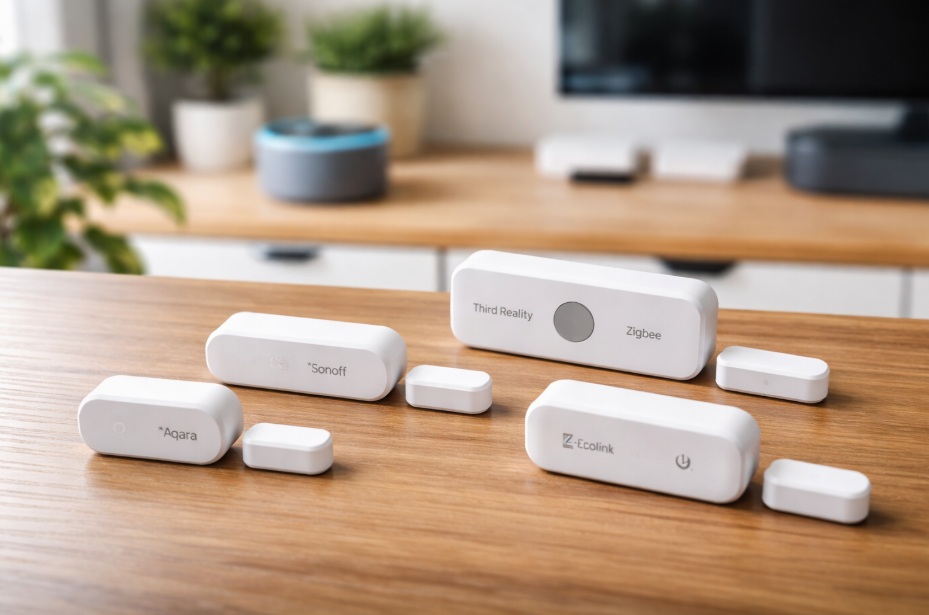
Third Reality Zigbee Contact Sensor
The Third Reality Zigbee sensor was installed on four exterior doors in mid-2022. As of mid-2024, battery levels remain around 33 percent using two AAA batteries.
Key observations:
- No reliability issues reported
- Quick response time suitable for security use
- Optional screw mounting available
- Approximately $20 per unit
Among Zigbee options, this sensor stands out for battery longevity and use of standard AAA batteries.
Ecolink Z-Wave Contact Sensor
The Ecolink Z-Wave sensor has been in service for over five years.
Characteristics include:
- One CR123 battery
- Roughly 12 to 18 months battery life
- Ability to connect to external wired sensors
- Larger physical size
- Approximately $32 per unit
Its ability to integrate legacy wired sensors makes it particularly attractive for homes with pre-existing alarm wiring.
Aqara Zigbee Contact Sensor
Aqara’s compact Zigbee sensor promises two years of battery life using a CR1632 coin cell. Battery reporting is less granular, often showing 100 percent until failure.
Advantages include:
- Extremely small form factor
- Matter support via Aqara M2 Hub
- Affordable pricing
Limitations include less transparent battery monitoring and potential Zigbee standard deviations.
SwitchBot Bluetooth Contact Sensor
The SwitchBot sensor uses Bluetooth and runs on two AAA batteries. Estimated battery life is around one year, with higher consumption than others in this review.
Unique features:
- Integrated motion sensor
- Integrated light sensor
- Matter compatibility via SwitchBot Hub 2
- Approximately $25 per unit
The additional sensing capabilities provide contextual intelligence, such as distinguishing approach direction based on motion timing.
Standalone Door and Window Sensors Outside Home Assistant
Not all sensors are designed for full smart home platforms. Some prioritize simplicity.
TECKNET TK-WA901
The TECKNET TK-WA901 functions as a portable alarm. When separated by more than 0.8 inches, it triggers a 100 dB siren.
Features include:
- Alarm, chime, and off modes
- Three-level volume control
- Adhesive mounting
- Portable design
- 36-month warranty with registration
It suits travel or quick security upgrades without ecosystem integration.
AQARA P2 Sensor
The AQARA P2 sensor supports Matter over Thread and works with Apple Home, Alexa, Google Home, and SmartThings.
Highlights:
- Hall sensor precision
- Real-time alerts
- Local automation without internet dependency
- Voice assistant compatibility
- Requires Matter-compatible hub and Thread router
It balances privacy, speed, and cross-platform support.
RING Alarm Contact Sensor 2nd Generation
The Ring Alarm sensor integrates with the Ring Alarm base station and works with both first and second-generation systems.
Key aspects:
- Slim removable magnet
- Two 3V lithium batteries
- Alexa battery notifications
- Tool-free installation
It fits naturally into the Ring ecosystem.
SANJIE Wireless Sensor
SANJIE offers a wireless chime-style system with:
- 55 selectable tones
- Five volume levels up to 110 dB
- 300-meter range
- LED indicators
- Memory retention for settings
Ideal for retail environments or households monitoring frequent entry points.
AQARA TZ-006 Sensor
The AQARA TZ-006 sensor supports Apple HomeKit and Alexa via the Aqara Hub.
Features include:
- Phone notifications
- Local hub alarm
- Lighting automations
- Up to two-year battery life
- Maximum 0.87-inch magnet distance
It combines security and daily automation potential.
Final Thoughts: Choosing the Right Contact Sensor
There is no universally perfect contact sensor. The ideal choice depends on:
- Preferred protocol
- Ecosystem compatibility
- Battery type preference
- Physical size constraints
- Need for additional sensing features
For Zigbee users prioritizing reliability and standard batteries, Third Reality stands out. Z-Wave users with legacy wiring may prefer Ecolink. For ultra-compact installations, Aqara remains compelling. If contextual motion sensing matters, SwitchBot offers unique advantages.
Ultimately, contact sensors represent one of the simplest yet most transformative components in smart home design. Their value lies not only in detecting open or closed states, but in the layered automations and contextual awareness they enable.
When thoughtfully deployed, these small devices help automate the mundane, reinforce security, and subtly elevate everyday living.