Kitchen work has always involved a blend of speed, coordination, and resilience. In both homes and restaurants, tasks such as washing dishes, clearing tables, and preparing basic items often consume hours of repetitive labor. These activities rarely attract attention, yet they represent a large share of the daily workload in food service and household management. Robotics developers have increasingly turned their attention to these overlooked tasks, viewing them as ideal candidates for automation.
Recent developments in kitchen robotics suggest that this shift is moving beyond experimental demonstrations. Several systems are now designed to operate in messy, unpredictable environments such as restaurant kitchens and family homes. Robots like Armstrong, Spotless by Nala, Memo from Sunday Robotics, and the Helix robotic system illustrate how advances in robotic manipulation, machine learning, and physical AI are bringing practical automation into spaces long considered too chaotic for machines.
Instead of narrowly focused machines performing a single action, these systems aim to combine perception, dexterity, and adaptability. The result is a new generation of robots that can cook, clean, handle fragile objects, and learn from real-world experience. Together, they offer a glimpse into how kitchen labor could change as intelligent machines begin to take on everyday chores.
The Rise of Robots in Kitchen Work
For decades, robots excelled primarily in structured environments such as factories, where tasks were repetitive and predictable. Kitchens, by contrast, are messy spaces filled with liquids, heat, grease, and constantly changing objects. Plates stack unpredictably, glasses slip easily, and utensils come in countless shapes and arrangements.
Because of this complexity, kitchen work has remained largely dependent on human labor. However, advances in sensing, computer vision, and machine learning have begun to bridge that gap.
Modern kitchen robots are designed to cope with conditions that previously made automation difficult:
- Wet surfaces and water exposure
- Grease, food residue, and irregular objects
- Constant repetition of cleaning tasks
- Random arrangements of dishes and cookware
- Fragile materials such as glass and ceramic
The shift is driven not only by technological progress but also by practical demand. Restaurants face labor shortages, rising operational costs, and increasing pressure to maintain consistent service quality. Automation that can reliably handle repetitive tasks such as dishwashing or prep work offers a potential solution.
The result is a growing ecosystem of robotic systems that combine machine learning with mechanical dexterity. Rather than replacing entire kitchen workflows overnight, these systems target specific bottlenecks that consume time and effort.
Armstrong and the Emergence of General-Purpose Kitchen Robots
Among the most ambitious developments is the Armstrong general-purpose robot. Designed to operate inside real kitchens, the system focuses on performing a range of routine tasks rather than a single specialized action.
Armstrong represents a broader trend toward physical AI systems that can manipulate objects and operate within dynamic environments. Instead of requiring tightly controlled conditions, the robot is designed to function amid the chaos typical of professional kitchens.
The system handles multiple forms of kitchen work, including:
- Cooking assistance
- Cleaning workflows
- Routine preparation tasks
- General kitchen maintenance
What distinguishes Armstrong is its emphasis on durability and continuous operation. Kitchens expose equipment to harsh conditions such as heat, moisture, grease, and nonstop activity. For a robot to function in this environment, it must withstand these stresses while maintaining consistent performance.
The system has already been deployed inside a large restaurant chain, where it operates continuously in a dishwashing role. Running around the clock, it performs one of the most demanding and repetitive jobs in the food service industry.
Dishwashing in restaurants often involves long shifts, constant water exposure, and heavy workloads. Robots capable of handling these conditions offer a way to stabilize operations while freeing human workers to focus on higher-value tasks.
Spotless by Nala: Robotic Dishwashing as a Complete Workflow
While general-purpose robots represent a long-term vision, some systems focus on solving a specific challenge with greater precision. Spotless by Nala is one such example, designed as a fully automated dishwashing solution for professional kitchens.
Dishwashing may appear straightforward, but large-scale operations involve far more than rinsing plates. Kitchens must handle a wide variety of items, including cookware, utensils, glasses, and dishware, all of which require different handling techniques.
Spotless approaches the problem as a complete workflow rather than a single task. Using high-performance camera systems and machine learning, the robot performs multiple stages of the dishwashing process.
Its capabilities include:
- Removing food waste from dishes
- Rinsing and cleaning cookware and utensils
- Washing dishware and glassware
- Drying items after cleaning
- Stacking and storing cleaned items
The system can manage hundreds of different types of utensils and kitchenware. This variety is a major challenge for automation because objects differ in size, shape, and fragility. Vision systems and learning algorithms allow the robot to identify items and handle them appropriately.
Another important aspect of Spotless is its compatibility with existing kitchens. Many automation systems require major redesigns of workspaces, which can make adoption difficult. Spotless is designed to integrate into professional kitchens with minimal changes to the layout.
This approach reflects a broader trend in service robotics. Instead of forcing businesses to redesign operations around robots, developers increasingly design robots that adapt to existing environments.
Memo: Bringing Robotic Chores Into the Home
While restaurant automation addresses operational efficiency, robotics developers are also targeting the home. Household chores such as clearing tables, loading dishwashers, and preparing drinks consume time that many people would rather spend elsewhere.
Memo, developed by Sunday Robotics, is designed to address this gap. Unlike many consumer robots that perform limited tasks, Memo aims to operate within the unpredictable conditions of everyday homes.
Real homes present challenges that differ from professional kitchens:
- Clutter from daily life
- Pets and children moving unpredictably
- Objects left in unusual positions
- Variations in furniture and appliances
Memo is built to navigate these conditions while performing practical household tasks. In demonstrations, the robot has shown the ability to approach an espresso machine, prepare coffee, and deliver the finished drink.
This process involves several coordinated steps:
- Filling the portafilter with coffee
- Tamping the grounds
- Starting the brewing process
- Delivering the prepared drink
Although this might appear simple, the task requires precise manipulation and object recognition. The robot must handle equipment designed for human use while adjusting its movements based on the environment.
Memo is trained using glove-based human demonstrations. In this approach, human operators perform tasks while wearing sensor-equipped gloves. The robot learns from these demonstrations, gaining insights into the dexterity and hand movements required for manipulation.
This training method allows Memo to develop more flexible behaviors than traditional robots programmed with rigid instructions. As a result, it can adapt to the unpredictable layouts and object arrangements typical of real homes.
The first beta units of Memo are planned for release in 2026, allowing early users to explore how robots might integrate into everyday life.
Helix and the Challenge of Robotic Dish Loading
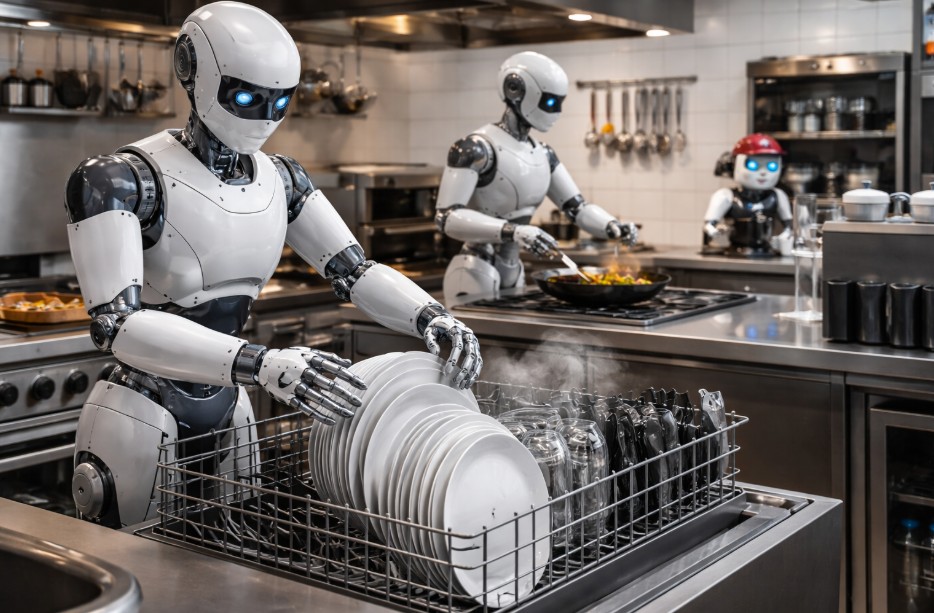
Dishwashing may appear routine, but loading a dishwasher presents a surprisingly complex challenge for robots. Items come in random arrangements, and dishes often stack or overlap in ways that require careful manipulation.
The Helix robotic system demonstrates how modern robotics can tackle this problem. Previously used for tasks such as folding towels and sorting packages, Helix now applies its capabilities to dishwasher loading.
The process involves several distinct skills:
- Separating stacked plates
- Handling fragile glassware
- Adjusting grips dynamically
- Arranging items neatly in racks
Helix performs these tasks with high precision, carefully aligning dishes before placing them into the rack. Glasses can be transferred between hands and repositioned to ensure proper placement.
One notable feature is the system’s ability to recover from mistakes. If a grip slips or an object shifts unexpectedly, the robot adjusts and continues working rather than stopping.
This adaptability is possible because Helix relies on learning from data rather than rigidly programmed instructions. Instead of writing new code for every task, developers train the system with additional data so it can learn new behaviors.
As a result, Helix has applied the same underlying system to multiple tasks that appear very different from one another. Laundry handling, package sorting, and dish loading all rely on similar principles of perception, manipulation, and learning.
This approach suggests that future robots may not be limited to single-purpose roles. Instead, they could gradually acquire new capabilities as they encounter more situations and training data.
Physical AI and the Future of Robotic Manipulation
At the heart of these developments lies the concept of physical AI. Unlike traditional AI systems that focus on digital tasks, physical AI integrates machine learning with mechanical interaction in the real world.
For robots operating in kitchens and homes, this means combining several capabilities:
- Visual perception of objects and environments
- Dexterous manipulation of tools and utensils
- Adaptive learning from experience
- Recovery from unexpected situations
Physical AI enables robots to handle environments that are not perfectly organized. Kitchens, in particular, present an ideal testing ground because they contain a wide range of objects, surfaces, and unpredictable events.
Advances in sensors and computing power allow robots to analyze their surroundings in real time. Machine learning models then guide movements, helping the robot determine how to pick up, move, or place objects safely.
This combination of perception and action represents one of the most challenging areas in robotics. Yet it is also the key to unlocking applications in everyday environments.
Economic and Operational Implications
The deployment of kitchen robots is closely tied to economic pressures in industries such as food service. Restaurants must manage fluctuating labor availability while maintaining consistent quality and hygiene standards.
Automation offers several potential advantages:
- Continuous operation without shift changes
- Consistent performance across repetitive tasks
- Reduced workload for staff
- Improved operational stability
Dishwashing, in particular, is a labor-intensive process that often involves long hours and difficult working conditions. Robots capable of performing this work continuously could transform how restaurants allocate labor.
For households, the value proposition is slightly different. Instead of addressing labor shortages, home robots promise to free up time spent on routine chores. Tasks such as clearing tables or loading dishwashers could become automated background activities rather than daily obligations.
Limitations and the Road Ahead
Despite impressive demonstrations, kitchen robotics is still in an early stage of development. Systems such as Memo and Helix illustrate what is possible, but they also highlight the complexity of working in real environments.
Robots remain slower than humans in many tasks and sometimes require multiple attempts to complete a movement. Learning systems also depend heavily on training data, meaning their performance improves gradually over time.
Nevertheless, the trajectory is clear. As robots accumulate more experience and developers refine their algorithms, capabilities are likely to expand.
The broader shift may resemble the early days of personal computing. Initial systems may seem limited compared to human abilities, yet they introduce a foundation that evolves rapidly as technology improves.
Conclusion
Kitchen automation is entering a new phase in which robots are beginning to operate in real environments rather than controlled laboratory settings. Systems such as Armstrong, Spotless by Nala, Memo, and Helix demonstrate that tasks once considered too messy or complex for machines are becoming viable targets for automation.
Dishwashing, table clearing, coffee preparation, and other routine chores are gradually being reimagined as robotic workflows. Advances in machine learning, perception, and dexterous manipulation allow robots to adapt to unpredictable conditions that once limited their usefulness.
For restaurants, these technologies promise improved operational efficiency and resilience in the face of labor challenges. For households, they hint at a future where routine chores fade into the background of daily life.
While the technology is still evolving, the direction is unmistakable. Kitchens, long considered one of the most human-centric workspaces, are becoming one of the next frontiers for practical robotics. As robots continue learning and expanding their capabilities, the line between human labor and machine assistance inside the kitchen will likely become increasingly blurred.