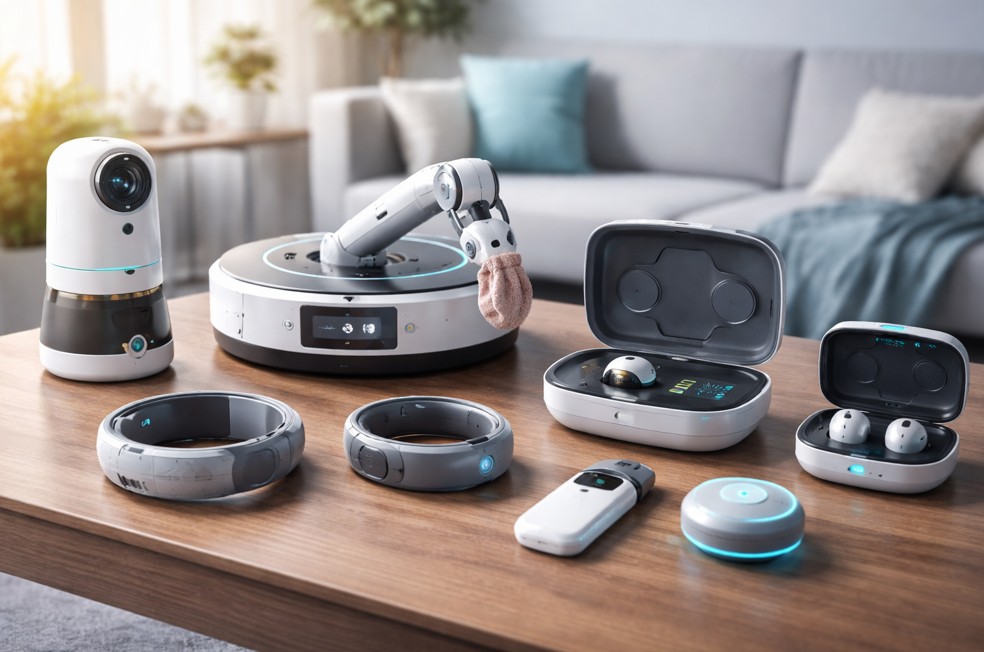
The AI hardware market crossed a staggering threshold this year, with spending reaching tens of billions of dollars and new devices launching almost weekly. Yet behind the glossy demos and futuristic marketing, most AI gadgets fail to justify their existence beyond novelty. Many introduce friction instead of removing it, demand subscriptions without delivering sustained value, or solve problems users never had in the first place. What separates the few meaningful products from the many forgettable ones is not how advanced the underlying AI sounds, but how effectively it integrates into daily life without demanding constant attention.
This article examines a carefully selected group of AI gadgets that demonstrate genuine utility. These devices are not speculative concepts or hype-driven accessories. Each one meaningfully improves productivity, reduces cognitive load, enhances well-being, or automates routine tasks in ways that feel practical rather than intrusive. At the same time, it is equally important to examine a smaller set of highly promoted devices that fail to meet these standards, not because AI is incapable, but because the design choices undermine trust, usability, or basic human comfort.
The $50 Billion AI Gadget Reality Check
The rapid expansion of AI hardware has created a paradox. On one hand, advances in speech recognition, biometric sensing, and real-time inference have made it technically possible to build devices that feel almost magical. On the other, commercial pressure has encouraged manufacturers to rush products to market before they are mature, often leaning on buzzwords instead of thoughtful integration.
Most AI gadgets fail because they ask users to adapt their behavior to the device, rather than quietly adapting to the user. Devices that require frequent charging, constant correction, awkward social signaling, or intrusive data capture quickly become liabilities. The few that succeed share a common philosophy. They remove friction, fade into the background, and deliver value without demanding trust they have not earned.
Plaud NotePin and the Rise of the External Brain
The Plaud NotePin represents one of the clearest examples of AI augmenting human cognition rather than attempting to replace it. Designed as a compact, clip-on device, it continuously records meetings, calls, and spoken ideas when activated, then converts that raw audio into structured outputs that are immediately usable.
What distinguishes this device is not transcription alone, but what happens after transcription. The system organizes content into summaries, task lists, follow-up items, and even visual mind maps. Instead of forcing users to reread long transcripts, it surfaces intent and action. This approach aligns well with how professionals actually work, particularly in environments where conversations move quickly and documentation often lags behind.
With roughly ten hours of battery life, 64 GB of onboard storage, and seamless Bluetooth connectivity to a phone, the hardware stays out of the way. While it does require a subscription on top of the upfront cost, the value proposition rests on time saved and mental clarity gained. For professionals in sales, management, or consulting, the device functions less like a recorder and more like a cognitive prosthetic that quietly fills the gaps human memory leaves behind.
Apollo Neuro Wearable and Real-Time Stress Regulation
Unlike productivity tools that focus on information, the Apollo Neuro wearable targets the nervous system itself. Worn on the wrist, the device delivers low-frequency vibrations designed to influence the body’s stress response in real time. The goal is not stimulation, but regulation.
By learning user biometrics over time, the wearable adapts its vibration patterns to signal safety to the brain. This can promote calm during stressful situations, sharpen focus during demanding tasks, and support faster sleep onset at night. The underlying approach draws on neuroscience research commonly applied in clinical contexts, including PTSD studies, which lends credibility to its design philosophy.
The effect is subtle rather than dramatic. Users do not experience a sudden shift, but over the course of days, patterns emerge. Meetings feel less tense, traffic becomes more tolerable, and sleep improves without deliberate effort. While the device is priced at a premium, its value lies in addressing an invisible cost of modern life: chronic stress that quietly erodes productivity and health.
Bee Pioneer Edition and Passive Life Logging
The Bee Pioneer Edition takes a different approach to cognitive support by acting as a passive observer of daily life. Clipped onto clothing, it quietly records conversations, reminders, and spoken intentions, then converts them into searchable daily summaries and automatically generated to-do lists.
The appeal here is simplicity. There is no complex setup, no subscription fee, and no requirement to consciously manage the device. Saying “book a flight” or “call John” is enough for the system to recognize intent and add tasks accordingly. In effect, it functions as a silent personal assistant that never forgets.
The trade-off is selectivity. Because the device records ambient audio, it can occasionally capture irrelevant background noise from televisions or radios, which may clutter task lists. Still, for users who value recall over precision, the Bee Pioneer Edition offers a low-friction way to externalize memory without ongoing costs or attention demands.
Timekettle W4 Pro and the Disappearing Language Barrier
Real-time translation has long been promised as a hallmark of AI, but the Timekettle W4 Pro demonstrates how far the technology has actually come. These earbuds translate live conversations across more than 40 languages, enabling natural dialogue between speakers who share no common language.
The system operates with latency under one second and achieves translation accuracy around 95 percent, which is sufficient for business meetings, travel interactions, and everyday communication. Bone conduction microphones ensure that the wearer’s voice remains clear even in noisy environments like airports.
At a premium price point, the W4 Pro is an investment rather than an impulse buy. However, for frequent travelers or professionals working with global clients, it removes a barrier that traditionally required human interpreters or awkward pauses. In doing so, it shifts AI translation from a novelty into a genuinely enabling tool.
RingConn Gen 2 Air and Subscription-Free Health Tracking
Health tracking wearables are often undermined by recurring subscription fees that gate essential insights behind monthly payments. The RingConn Gen 2 Air takes a different stance by offering comprehensive health monitoring with no ongoing costs.
The ring tracks sleep, heart rate variability, stress levels, and even sleep apnea indicators using medical-grade sensors. With a battery life of up to 12 days and a lightweight design, it is easy to forget the device is even being worn. Data syncs automatically, providing continuous insight without manual intervention.
By charging a one-time price and delivering full functionality upfront, the RingConn positions itself as a long-term companion rather than a recurring expense. For users wary of subscription fatigue, this model feels refreshingly straightforward.
Mudra Link Neural Wristband and Gesture-Based Control
The Mudra Link neural wristband offers a glimpse into a future where physical interaction with devices becomes optional. By reading the electrical signals sent from the brain to the hand, it enables users to control devices through subtle finger movements and gestures.
Once calibrated, the wristband can scroll presentations, control media playback, and navigate computers without physical contact. It works with standard Bluetooth devices and has been recognized with a CES 2025 Innovation Award.
There is a learning curve. Early use can feel unintuitive, as users essentially retrain their hands to communicate differently. However, with practice, the system becomes surprisingly accurate. While still early-stage technology, it stands out as one of the few wearables that genuinely suggests a new interaction paradigm rather than repackaging existing inputs.
Furbo Mini 360 and AI-Driven Pet Monitoring
For pet owners, anxiety often stems from uncertainty rather than absence. The Furbo Mini 360 addresses this by combining a rotating camera with AI-based behavior detection. The device can identify barking, howling, chewing, unusual movement, and even environmental alerts like smoke alarms.
It does more than observe. The camera can toss treats, rotate to follow movement, and allow two-way audio communication. Importantly, it distinguishes between normal play and signs of distress, reducing false alarms.
While advanced alerts require a monthly fee, the value lies in peace of mind. For owners who travel or work long hours, the ability to check in and respond to real issues in real time can justify the ongoing cost.
Wispr Flow and Voice-First Productivity
Wispr Flow focuses on a simple insight: many people think faster than they type. This software turns spoken words into well-formatted text in real time, achieving speeds of over 170 words per minute. It adapts to individual writing styles, terminology, and phrasing, improving accuracy with use.
The system works across applications, from email clients to code editors, making it broadly applicable. Unlike flashy hardware, Wispr Flow succeeds by quietly amplifying output. After sustained use, it can even anticipate sentence structure, reducing friction between thought and execution.
For writers, developers, and creators, this kind of voice-first workflow can fundamentally change how work is produced, not by adding complexity, but by removing a bottleneck.
Google Nest Learning Thermostat and Invisible Intelligence
Some of the most effective AI systems are the ones users rarely think about. The Google Nest Learning Thermostat exemplifies this philosophy by optimizing home heating and cooling without requiring manual programming.
By learning user schedules and preferences, it automatically adjusts temperature settings to reduce energy consumption. Independent testing shows meaningful reductions in both heating and cooling costs. The device integrates seamlessly with other smart home systems and provides clear feedback on energy usage.
Its value accumulates quietly over time. There is no dramatic moment of interaction, just steady savings and increased comfort. In many ways, this understated effectiveness is what AI hardware should aspire to.
Roborock Saros Z70 and the Edge of Consumer Robotics
The Roborock Saros Z70 pushes robotic vacuum design into more ambitious territory. In addition to powerful suction and sonic mopping, it features a mechanical arm capable of picking up small obstacles like socks or tissues and placing them into a bin.
The system includes a fully automated dock that handles maintenance tasks, reducing user involvement. However, the arm is not flawless and can miss objects, and the price places it firmly in early-adopter territory.
Despite its imperfections, the Saros Z70 represents a meaningful step toward more autonomous home robotics. It is less about immediate practicality and more about demonstrating what is becoming possible.
When AI Gadgets Go Wrong: Friend AI Necklace and Limitless Pendant
Not all AI wearables enhance life. The Friend AI Necklace attempts to act as a personal AI companion by continuously listening and responding. In practice, it creates discomfort. Constant recording raises social and privacy concerns, responses often miss context, and the presence of the device can make others uneasy.
The Limitless Pendant fares even worse. Battery life is unreliable, voice recognition is inconsistent, and summaries can be misleading or tone-deaf. More fundamentally, it violates an unspoken social contract. People do not want to be recorded continuously, especially by a device that offers little control or reliability.
These failures highlight an important lesson. Utility cannot come at the expense of trust. Devices that ignore social norms or privacy expectations undermine themselves regardless of technical ambition.
What Truly Matters in AI Hardware
The AI gadgets that succeed in 2026 share a common trait. They remove friction. They save time, reduce stress, and operate quietly in the background. They respect user attention, social context, and privacy boundaries.
The ones that fail do the opposite. They demand trust without earning it, introduce awkwardness into daily interactions, or prioritize data collection over user comfort. As AI continues to move from software into physical devices, these distinctions will only become more important.
Smart technology should not constantly remind users of its presence. When AI hardware works best, it fades into the flow of daily life, leaving only the benefits behind.