Home security cameras have moved from niche devices into mainstream household technology, yet selecting the right system remains surprisingly complex. The market is saturated with brands, specifications, and feature lists that often obscure what actually matters in day-to-day use. For homeowners trying to protect their families, property, and peace of mind, the challenge is not finding options but filtering out the wrong ones.
This guide breaks down ten critical considerations that directly influence how effective a home security camera system will be over time. Rather than focusing on marketing language or novelty features, it concentrates on reliability, real-world performance, and long-term value. The goal is to help homeowners think clearly about what they are buying, why they are buying it, and how different design choices affect security outcomes in practical environments.
Wired Systems Versus Wi-Fi Cameras
The first and most foundational decision when selecting a home security camera system is whether to choose a wired setup or rely on Wi-Fi-based cameras. This choice shapes nearly every other aspect of performance, scalability, and reliability.
Wired systems typically center around a network video recorder, commonly referred to as an NVR. These systems connect multiple cameras directly to the recorder using Ethernet cables, allowing video and power to travel through a single line. Most residential installations fall within the four to eight camera range, which aligns naturally with how homes are structured. Front, rear, sides, and garage areas can be covered methodically without overlapping blind spots.
Wi-Fi cameras, by contrast, operate independently and transmit footage over a home’s wireless network. They are easier to deploy, particularly when only one or two cameras are needed. However, they rely heavily on Wi-Fi strength, which is designed primarily for indoor use. Outdoor installations introduce signal degradation, interference, and reliability concerns that become more pronounced as the number of cameras increases.
In practice, wired systems are better suited for comprehensive exterior coverage, while Wi-Fi cameras often make sense for indoor monitoring or limited outdoor use where network strength is reliable and camera count is low.
Powering Your Cameras: Practical Trade-Offs
Power delivery is often overlooked until installation begins, yet it directly affects camera uptime, maintenance effort, and placement flexibility. Wi-Fi cameras typically offer three power options: direct electrical connection, battery operation, or solar-assisted charging.
For indoor cameras, plugging into a wall outlet is usually the simplest and most dependable solution. Power availability indoors is rarely a constraint, and constant power eliminates the need for battery management. Outdoor Wi-Fi cameras present a different challenge. Electrical outlets may not be available where coverage is needed, making battery-powered models appealing. However, batteries introduce ongoing maintenance and require physical access for recharging.
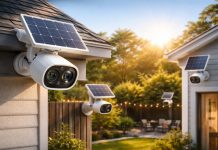
Solar panels reduce the frequency of battery intervention, but they add visual clutter and, in many cases, require a visible cable between the panel and the camera. Some integrated designs address this issue, but most solar solutions still involve trade-offs in aesthetics and placement.
Wired systems simplify power considerations by using Power over Ethernet. A single cable delivers both power and video from each camera back to the NVR, which itself requires only one electrical outlet. This centralized approach reduces failure points and simplifies long-term operation.
Balancing Price Against Long-Term Quality
Price is often the most emotionally charged factor in security decisions, but it is also one of the easiest to misjudge. The market contains a wide range of products that appear similar on paper but behave very differently over time.
In the Wi-Fi camera category, recognizable brands tend to offer more consistent performance and software support. Entry-level indoor cameras can be affordable while still delivering acceptable reliability for basic monitoring tasks such as watching pets or common living areas.
Wired systems exhibit a sharper quality divide. Lower-end systems commonly sold through mass retailers often appeal due to price, yet they tend to compromise on durability, image consistency, and long-term reliability. These compromises become apparent after installation, when failure rates rise and system limitations surface.
Professional-grade systems occupy a higher price tier but are engineered for continuous operation, weather exposure, and extended service life. When a wired system is intended to secure the entire perimeter of a home, quality differences translate directly into security outcomes. Investing once in a robust system often proves more economical than replacing unreliable hardware later.
Understanding Resolution Beyond Marketing Numbers
Resolution is frequently marketed as the defining feature of a security camera, yet its real-world value depends on how footage is used. Common resolutions range from 1080p through 2K and 4K, with higher options emerging.
For residential environments, 2K resolution occupies a practical middle ground. It provides sufficient clarity to identify people and vehicles at typical distances without the storage and bandwidth demands associated with higher resolutions. While 4K offers advantages when zooming into recorded footage, those benefits diminish when viewed live or from standard display distances.
Lower resolutions such as 1080p remain widespread, but they are increasingly dated for outdoor security applications. As cameras are mounted higher and fields of view expand, resolution becomes critical for maintaining usable detail. Higher resolutions only deliver value when paired with optics and sensors capable of supporting them effectively.
Night Vision as a Core Security Capability
Security incidents often occur under low-light conditions, making night vision performance a central concern rather than a secondary feature. Two primary factors define night vision effectiveness: distance and illumination method.
Many Wi-Fi cameras offer limited night vision ranges, often insufficient for elevated outdoor installations. Wired systems, particularly professional-grade models, provide significantly longer illumination distances, allowing broader coverage without sacrificing clarity.
Night vision can be delivered in black and white using infrared illumination or in color through visible lighting. Infrared systems rely on LEDs that can degrade over time, while color night vision often uses spotlights that may disturb neighbors or draw attention.
Some systems employ softer illumination methods that balance visibility with discretion. The method chosen affects not only image quality but also neighborhood compatibility and long-term reliability.
Placement Strategy Indoors and Outdoors
Camera placement determines how effectively a system translates technical capabilities into actual security coverage. Indoors, placement should prioritize capturing movement pathways such as hallways, staircases, and central living areas. A single well-positioned camera can often cover multiple zones if angles are considered carefully.
Outdoor placement focuses on entry points rather than open spaces. Doors, garages, and side access areas represent the most likely points of intrusion. Wired systems excel here due to their scalability, allowing multiple cameras to be deployed without compromising performance.
Aesthetic considerations also matter. Visible cabling, awkward mounts, and poorly planned angles can undermine both the appearance and effectiveness of a system. Thoughtful placement balances coverage, discretion, and installation practicality.
Stationary Cameras Versus Pan-Tilt Designs
The choice between fixed-view cameras and pan-tilt models often reflects assumptions about how homeowners interact with their systems. Stationary cameras provide constant coverage of a defined area and are generally more cost-effective. Multiple fixed cameras can cover overlapping zones, ensuring no movement goes unrecorded.
Pan-tilt cameras introduce flexibility and are valuable when actively monitored. However, most homeowners do not spend time manually controlling cameras. Automated tracking features attempt to address this gap, but they introduce risks when multiple subjects are present.
In many residential scenarios, having more stationary cameras positioned strategically delivers more reliable coverage than fewer movable units.
Audio Capabilities and Their Limitations
Audio features range from no audio at all to one-way and two-way communication. One-way audio allows listening without interaction, while two-way audio enables direct communication through the camera.
In theory, two-way audio supports proactive deterrence. In practice, audio quality limitations often reduce effectiveness, particularly outdoors. One-way audio can still be valuable for situational awareness, although it introduces constant ambient noise that some users find distracting.
Legal considerations also apply in certain contexts, especially where audio recording is involved. Audio features should be evaluated not as primary security tools but as supplementary capabilities with situational value.
Viewing Options and Redundancy
How footage is viewed influences how a system is used daily. Mobile apps have become the dominant interface, offering convenience and remote access. However, reliance on Wi-Fi introduces vulnerability during network outages.
Wired systems paired with monitors or televisions provide continuity even when internet connectivity fails. This redundancy ensures access to recorded footage regardless of network conditions.
The most versatile systems support multiple viewing methods, combining mobile access with local displays for resilience and convenience.
Smart Home Integration and Real-World Relevance
Smart home integration appeals strongly to some users while remaining irrelevant to others. Wi-Fi cameras generally offer broader compatibility with smart home platforms, enabling voice control and unified device management.
Wired systems prioritize reliability and performance over ecosystem integration. For many homeowners, the absence of smart home features is inconsequential as long as footage is accessible when needed.
The value of integration depends entirely on user priorities. It should be treated as an enhancement rather than a requirement when evaluating core security performance.
Final Perspective: Designing for Reliability Over Hype
Choosing a home security camera system is less about chasing the latest features and more about aligning technology with real-world needs. Reliability, coverage consistency, and long-term performance outweigh novelty in almost every scenario.
By focusing on these ten considerations, homeowners can move beyond surface-level comparisons and make informed decisions that hold up over time. Security technology works best when it fades into the background, quietly delivering peace of mind without constant adjustment or concern.