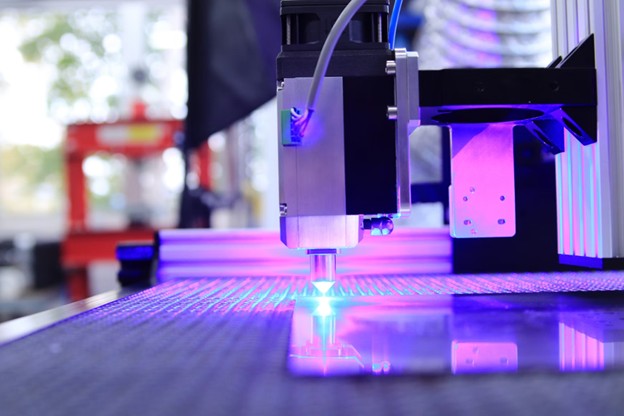
Laser cutting depends on precision, yet many shops still rely on careful setup, routine checks and post-cut inspection to maintain consistent outcomes. This pattern is changing as vision systems and smarter control software move from research labs into production. Newer machines can watch the cut as it happens, notice when the beam or the sheet starts to drift, and then adjust motion, focus or power on the fly. Over time, such built-in feedback turns a laser cutter into equipment that can keep itself dialed in through long runs and shifting materials.
Limits of Traditional Laser Cutting
Even well-maintained machines drift. Thermal expansion can shift optics and gantry geometry, nozzles wear out, lenses get contaminated and assist-gas behavior changes with humidity and supply pressure. Over time, these effects turn into taper changes, burr formation, edge roughness and dimensional errors. Operators often compensate by scheduling calibration and using conservative parameter settings, which slows throughput.
Material variability adds another layer. Sheet flatness varies by supplier and lot, while coatings and mill scale shift absorptivity. Carbon steel is a workhorse in fabrication, partly because its carbon content can reach about 2% to 2.5% by weight, boosting hardness and strength. However, that chemistry also raises brittleness risk, and the iron content makes corrosion a continuing concern for storage and handling decisions. These make consistent cutting harder when jobs mix gauges and alloys.
The cost of these limitations manifests right away. Scrap rises when the first parts of a run get dialed in. Rework grows when cut quality drifts mid-shift. Productivity drops when operators pause to inspect edges or chase intermittent defects. In high-mix environments, manual oversight can become the limiting factor even when the laser source and motion platform have headroom.
Core Components of an AI Vision System
AI-enabled laser cutting starts with a simple premise — measure what matters during the cut, interpret it immediately and close the loop with control authority. Research groups and industrial teams are converging on a common stack, with variations driven by budget, required tolerance and cycle time.
High-Resolution Cameras and Data Acquisition
Most self-correcting concepts begin with at least one camera that can see the process zone. A coaxial view through the cutting head is popular because it stays aligned with the beam path and captures plume behavior, kerf appearance and piece dynamics across the work envelope. Side-looking cameras can add sensitivity to bevel, spatter trajectories and edge condition, though they demand more calibration and are easier to occlude.
The camera stream rarely travels alone as systems often fuse encoder feedback, gas pressure signals and acoustic sensing. The direction of travel and local curvature matter for interpreting visual cues. In broader laser-based manufacturing, researchers have cataloged optical and acoustic monitoring approaches and highlighted how multi-sensor fusion enables closed-loop correction strategies.
Machine Learning for Real-Time Analysis
Raw images do not become corrections on their own. Models translate visual features into process state — focus offset, stand-off variation, kerf widening or a loss of coupling. Classical CV can handle some tasks, such as edge detection and blob tracking, yet modern approaches lean on lightweight CNNs, temporal models and sensor-fusion networks to stay resilient under changing illumination and material reflectivity.
Recent conference work points toward richer predictions that monitor quality metrics during cutting. In one multimodal approach, images combined with acoustic data were used to predict burr height and roughness. This demonstrates how models can move beyond simple defect flags toward qualitative estimation.
Actuators and Feedback Control Loops
A vision model becomes self-correcting only when the machine can act on what it learns. Typical actuators include Z-axis stand-off control, dynamic focusing optics, assist-gas valves and modulation of laser power or pulse parameters. Motion planners can also adapt the feed rate through corners or when pierce quality deteriorates. This mirrors a broader push in photonics toward learning-enabled control loops.
The Mechanism of AI-Powered Self-Correction
Self-correction in laser cutting usually blends predictive compensation and adaptive optimization, which together can keep performance resilient as conditions evolve.
Predictive Error Correction
Predictive control aims to forecast errors before they degrade the cut. Vision plays a key role here because many failures follow subtle precursors, such as plume asymmetry, kerf texture shifts or transient brightening near the interaction zone. When a model recognizes those signatures early, the controller can adjust focus, power or trajectory.
Scientists studied a machine learning method that corrects laser pointing errors in real time for pulse-to-pulse stabilization, framed as a practical implementation of predictive control. In tests on the BELLA Center Petawatt beamline, the team reported sub-microradian root-mean-square pointing to stabilization and large reductions in jitter relative to an uncontrolled case.
That work targets beam steering, but the conceptual match is strong for cutting systems where pointing, focus and stand-off error cascade into kerf geometry. A cutter can run a pilot observation channel through its process camera, predict where coupling will deteriorate over the next milliseconds and command a correction through the focus drive or Z axis.
Adaptive Optimization
Shop floors can still produce warped sheets and heat accumulation near dense nesting, changing reflectivity as coatings burn off. Adaptive optimization addresses these by learning a policy that maps observed state to corrective action without requiring a fully accurate process model.
Reinforcement learning is increasingly used for this role in photonics, especially where the system must optimize under drift and noise. Researchers demonstrated reinforcement learning for self-adjusting optical systems and discussed laser-plasma X-ray optimization by tuning focus position to stabilize signal output while compensating for oscillations and drift.
Applications in High-Precision Industries
Self-correcting laser cutting is gaining traction in industries where a small cut error can turn into costly rework later. Companies with strong measurement and quality programs are adopting it early because it catches drift during the cut rather than after parts stack up.
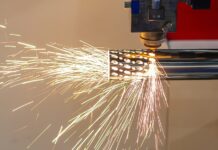
Fiber laser cutters are a common starting point, since they cut steel and aluminum with high precision at production speeds. This combination makes them a strong fit for auto and aerospace suppliers producing brackets, structural components and enclosures that need repeatable dimensions.
When used in auto parts making, the value is seen during long production runs where heat buildup, nozzle wear and slight alignment shifts can slowly degrade edges. Aerospace manufacturing also benefits when jobs cover different thicknesses and alloys.
Electronics and energy manufacturing see gains because edge quality affects fit and sealing. Battery enclosures, inverter housing and thermal plates often require consistent geometry and low residue for reliable assembly. The National Institute of Standards and Technology has highlighted how AI-based monitoring can evaluate and benchmark sensor-driven controls in industrial environments.
Self-Correcting Laser Cutting Is the New Baseline
AI vision systems are turning laser cutting into a closed-loop process where the machine watches the cut, detects drift and corrects it fast enough to maintain edge quality. With learning-based control working alongside industrial sensors and safety-bounded motion and power limits, cutters can remain consistent through mixed materials and extended production runs. This translates to fewer quality checks mid-run, less scrap from gradual drift and reliable output at production speeds.