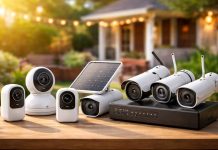
Home security has quietly shifted expectations. Many homeowners no longer want systems that demand constant interaction, whether that means charging batteries every few weeks, paying recurring subscription fees, or filtering through endless motion alerts. The appeal of solar powered security cameras lies in how they promise to remove friction rather than add it. By combining solar charging, local storage, and increasingly intelligent detection, these devices aim to stay present in the background, doing their job without demanding attention.
This article takes a deep look at five solar security cameras that represent different philosophies within that broader goal. Some prioritize visual coverage and zoom clarity, others focus on night performance or long-term power reliability, while a few lean into multi-camera coordination and system level organization. Together, they offer a clear view of how solar surveillance has matured from a niche idea into a practical option for everyday smart homes.
Why Solar Security Cameras Are Becoming the Default Choice
Solar security cameras appeal to a simple but powerful idea: surveillance that sustains itself. Instead of relying on wired power or frequent battery swaps, these devices use sunlight to remain operational for months or even years with minimal intervention. That shift changes how people think about placement, maintenance, and long-term cost.
From a practical standpoint, solar power removes many installation constraints. Cameras can be mounted on gates, sheds, side yards, or perimeter walls where running cables would be inconvenient or expensive. Over time, the absence of charging routines also changes user behavior. When a device does not demand upkeep, it is more likely to remain active and trusted rather than becoming another gadget that quietly falls into disuse.
Equally important is the move toward local storage and smarter alerts. Storing footage locally without mandatory subscriptions gives users a sense of ownership over their data. At the same time, advances in motion detection, object recognition, and tracking reduce unnecessary notifications. The result is a system that feels calmer and more intentional, which aligns well with how people want technology to fit into their homes.
1. Eufy SoloCam S340
One of the most common concerns around solar cameras is whether they can deliver meaningful visual detail while operating autonomously. The Eufy SoloCam S340 addresses that concern by rethinking how a single camera sees its environment.
Instead of relying on one lens to handle everything, this model uses a dual camera setup. One lens monitors a wide area, while the second focuses on distant details. In daily use, this separation proves valuable. Wide coverage ensures that general activity is always visible, while the zoom lens provides clarity when it matters most. Faces remain recognizable even at longer distances, and the eight times zoom feels usable rather than ornamental.
Power management is another strength. The adjustable solar panel requires only a few hours of sunlight to maintain operation, which makes it practical even in regions with frequent cloud cover. Once installed, charging becomes something users rarely think about. The camera’s full 360 degree movement further reduces blind spots, allowing it to follow activity around the property instead of watching a fixed slice of space.
Local storage without monthly fees reinforces the feeling that this is a one-time setup rather than an ongoing service. Over time, that distinction builds trust. The SoloCam S340 fits best in environments where wide coverage and minimal maintenance matter more than deep system customization, provided that a 2.4 GHz Wi-Fi network is available.
2. Botslab W510
While some cameras emphasize simplicity, others aim to give users deeper insight and control. The Botslab W510 falls firmly into the latter category, placing resolution and system intelligence at the center of its design.
The 4K footage produced by this camera is not just about higher numbers on a spec sheet. In practice, the added resolution translates into confidence during playback. Details such as clothing colors or license plates remain usable, even in low light conditions. Color night vision adds contextual richness, making scenes feel closer to what a person would actually see rather than a washed out approximation.
Storage flexibility is a defining feature. A local base station handles recordings without subscription fees, which already covers most household needs. For larger properties or multi-camera installations, expandable storage support allows the system to grow without forcing compromises. This scalability makes the W510 appealing for users who want a single ecosystem rather than a collection of isolated cameras.
Alert behavior also stands out. Notifications are more descriptive, explaining what triggered them instead of issuing generic motion warnings. That subtle change saves time and reduces mental load during busy days. Combined with 360 degree movement, autotracking, and cross-camera tracking through the base station, reviewing events feels organized instead of fragmented. The trade-off is a setup experience that feels more system-oriented than minimal, which may suit users who enjoy fine-grained control.
3. EufyCam S3 Pro
Nighttime performance often defines how much a security camera is truly trusted. The EufyCam S3 Pro approaches this challenge differently by focusing on sensor sensitivity rather than relying heavily on bright spotlights.
At night, footage appears surprisingly natural. Scenes remain bright and detailed without harsh lighting that can distort colors or draw unnecessary attention. This softer approach feels more comfortable when reviewing clips late at night and reduces the sense of constant surveillance glare around the home.
Solar Plus 2.0 introduces flexibility in installation. A built-in panel supports clean, self-contained setups, while an included external panel helps maintain reliability in shaded areas throughout the year. This dual option acknowledges that not all mounting locations receive consistent sunlight.
Detection accuracy is where the S3 Pro quietly earns long-term trust. By combining radar with passive infrared sensing, the system significantly reduces false alerts. Fewer unnecessary notifications mean that when an alert does arrive, it carries more weight. Over time, that difference matters more than raw detection sensitivity.
Local storage through a central home base keeps data private and consolidated, with expandable options available as needs grow. Smart home support adds convenience, although users should remain aware of resolution limitations within certain ecosystems. Overall, this camera suits those who value nighttime clarity and alert reliability over sheer coverage size.
4. Napcat 4K Solar Security Camera
As surveillance extends to larger properties and less frequently visited areas, power reliability becomes a critical concern. The Napcat 4K Solar Security Camera leans heavily into the idea of staying active without reminders.
A large internal battery paired with flexible solar panel placement creates a reassuring sense of endurance. Even brief periods of sunlight are often enough to keep the camera running for days. This reliability is particularly valuable for locations near trees, sheds, or side yards where light conditions vary.
Image quality remains sharp both day and night, with 4K resolution proving especially useful during later reviews. Small movements near gates or garages become easier to interpret, reducing ambiguity when assessing events. A wide viewing angle further minimizes the need for additional cameras to cover corners or adjacent zones.
Local storage comes pre-installed, lowering setup friction and reinforcing the absence of recurring fees. Over time, this approach builds confidence in the system. Proactive features such as strobe lights and sirens add a deterrent layer, although they work best when carefully tuned to avoid unnecessary activation.
Multi-channel viewing and offline access provide additional flexibility, especially for users who prefer monitoring footage on a dedicated screen. The system’s size and hub-based architecture make it better suited for fixed locations rather than discreet placements, but for long runtime and control, it offers a compelling balance.
5. YOYIRYB 4K Solar Security Camera
Security often becomes more complex as the number of cameras increases. The YOYIRYB 4K Solar Security Camera addresses this complexity by emphasizing coordination rather than treating each camera as an isolated device.
Dual-band Wi-Fi support improves connection stability, particularly in homes where the 2.4 GHz band is already crowded. This stability matters when multiple cameras are streaming or recording simultaneously. Zoom capabilities feel practical at closer ranges, making it easier to check packages, pets, or activity near driveways.
Video clarity remains consistent enough for quick reviews, but the real strength lies in how feeds are organized. Viewing multiple cameras on a single screen saves time, especially when activity moves across different zones. Instead of jumping between apps or timelines, events align in a more coherent sequence.
Full rotation and autotracking help reduce blind areas, allowing the system to follow movement naturally. For families, this coordination can be useful beyond security, such as keeping an eye on children or pets in open outdoor spaces. Local storage without fees and offline recording ensure continuity even during network disruptions.
Setup remains approachable, and expanding coverage over time feels manageable. Two-way communication and alert customization focus on practicality rather than spectacle. This camera suits users who value coordinated oversight and flexible expansion, as long as app-based management fits their daily routine.
Comparing Strengths Across Different Use Cases
Each of these cameras reflects a different interpretation of what solar security should prioritize. Rather than ranking them universally, it is more useful to consider how their strengths align with specific needs.
For users seeking minimal upkeep and broad coverage, a camera with reliable solar charging and wide movement may feel ideal. Those who want detailed forensic playback and organized event review may gravitate toward higher resolution systems with base stations and cross-camera tracking. Night-focused users may prioritize sensor quality and detection accuracy, while large properties benefit most from extended battery life and endurance.
Common themes emerge across all five options:
- Solar power has reached a level of reliability where frequent manual charging is no longer expected.
- Local storage without mandatory subscriptions is becoming a baseline rather than a premium feature.
- Intelligent detection and tracking reduce alert fatigue and improve trust in notifications.
- System design increasingly considers how multiple cameras interact, not just how one performs in isolation.
These shared characteristics suggest a broader maturation of the category rather than isolated innovation.
What This Evolution Means for Smart Home Security
The shift toward solar powered security cameras reflects a larger trend in smart home technology. Devices are no longer judged solely by how many features they offer, but by how quietly and reliably they integrate into daily life. In this context, solar power is less about sustainability alone and more about reducing cognitive load.
As detection algorithms improve and storage becomes more user-controlled, the relationship between homeowners and their security systems changes. Instead of constant vigilance, there is a growing expectation of calm oversight. Technology fades into the background until it is genuinely needed.
For robotics and automation enthusiasts, this evolution is instructive. It shows how autonomy, energy management, and intelligent perception converge in consumer products. Solar security cameras are, in many ways, small autonomous systems operating at the edge of the smart home. Their success depends not on novelty, but on reliability, restraint, and thoughtful design.
Final Thoughts
Choosing the right solar security camera is less about chasing specifications and more about understanding priorities. Whether the goal is wide coverage, night clarity, long-term endurance, or coordinated multi-camera oversight, the current generation of solar cameras offers viable options without imposing constant demands.
What stands out most is how these systems aim to simplify rather than complicate. By combining solar power, local storage, and smarter detection, they move closer to the ideal of security that is always present but rarely intrusive. For homeowners and technologists alike, that balance represents a meaningful step forward in how intelligent systems coexist with everyday life.