A truly smart home is not defined by how many connected devices it has, but by how naturally it responds to human presence. Motion sensors sit quietly at the center of that experience. They do not attract attention like smart displays or voice assistants, yet they often determine whether a home feels intelligent or merely automated. When used thoughtfully, motion sensors turn routine actions such as switching on lights, securing spaces, or maintaining comfort into background processes that simply happen when needed.
Motion sensors are often introduced early in a smart home journey, usually after basic lighting or contact sensors. What makes them powerful is not complexity but flexibility. They can work alone, cooperate with other sensors, or serve as the trigger for layered automations that adapt to time, context, and behavior. Understanding how they work, where they excel, and where they fall short is essential for anyone serious about building a responsive home environment.
Understanding What a Motion Sensor Really Does
At its core, a motion sensor is a compact device designed to detect movement within a defined field of view and report that activity to a smart home platform. While early security systems used bulky detectors with limited accuracy, modern motion sensors are smaller, faster, and significantly more capable. Despite their compact form, they serve as one of the most important inputs into home automation logic.
Most contemporary smart home motion sensors rely on passive infrared technology. These sensors emit infrared light and monitor changes in heat patterns within their detection area. When a warm object such as a human body moves across that field, the sensor registers a change and reports motion. The simplicity of this approach is also its strength. There is no need for cameras, continuous monitoring, or complex processing. The sensor simply watches for changes and reacts.
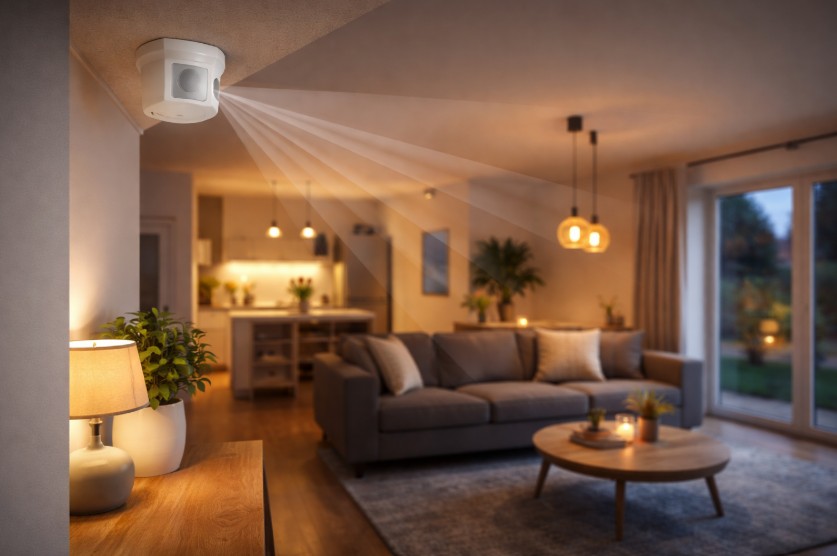
Detection range and field of view have improved steadily. Older models often struggled beyond three or four meters and covered relatively narrow angles. Newer sensors commonly reach distances of around six meters and offer wide fields of view that can exceed 120 degrees. This allows a single device to monitor larger spaces more reliably than before. Improvements in sensitivity also mean faster detection, reducing the delay between entering a room and triggering an automation.
Motion Detection vs Presence Detection
While motion sensors detect movement, they do not confirm continued occupancy. This limitation has led to the development of presence detectors, which operate on a different principle. Presence detection does not rely on visible movement. Instead, it creates a field that can identify whether a person remains within a space, even if they are standing still.
This distinction matters in real-world use. A motion sensor may fail to detect someone who is sitting quietly or working at a desk, eventually concluding that the room is empty. A presence detector continues to recognize occupancy and prevents automations from shutting down lights or climate systems prematurely.
However, presence detectors come with trade-offs. They are more expensive, more complex to configure, and often unnecessary in transitional spaces such as hallways or garages. Brands such as Aqara have introduced advanced presence detection products that work well in specific scenarios, but motion sensors remain the most practical option for most rooms. The cost difference alone makes it sensible to reserve presence detection for areas where stationary occupancy is common, such as offices or living rooms, while relying on motion sensors elsewhere.
Lighting Automation as the Primary Use Case
Lighting control is where motion sensors deliver the most immediate and visible benefit. The ability to walk into a room and have lights turn on automatically feels natural almost instantly. Over time, it becomes difficult to imagine returning to manual switches in frequently used areas.
Motion sensors solve a key limitation of contact sensors. A door sensor can trigger lights when a door opens, but it cannot account for what happens after the door closes. Motion detection fills that gap by confirming continued activity. As long as movement is detected, lights remain on. When motion stops for a defined period, the system turns them off.
This approach works especially well in spaces without doors. Kitchens, open-plan living areas, and hallways benefit significantly from motion-based lighting. In large rooms, a single sensor may not be enough to cover all activity zones. Strategic placement or multiple sensors may be required to ensure consistent detection.
Effective lighting automation depends on timing. Immediate shutoff rarely works well. Most setups benefit from a delay ranging from one to five minutes after motion stops. This buffer accounts for moments of stillness and prevents lights from turning off while someone is still present. Adjusting this delay is often more important than the sensor hardware itself.
Motion Sensors in Home Security Scenarios
Security is another classic application for motion sensors, and it remains highly relevant in smart homes. Motion sensors can act as silent observers, watching for unexpected activity when a home is unoccupied or during specific hours.
Unlike traditional alarm systems that react immediately, smart home motion sensors can be time-aware and context-sensitive. Motion detected during the day may be ignored, while the same motion at night can trigger alerts, lights, or sirens. Sensors placed in garages, main living areas, or entry points can provide coverage without the need for cameras in every room.
Motion-based security also integrates well with other sensors. A motion trigger combined with a contact sensor or alarm state can reduce false alerts. For example, motion may only generate notifications when the alarm system is armed. This layered logic allows motion sensors to remain active at all times while only escalating when conditions warrant it.
Creative and Practical Automation Ideas
Beyond lighting and security, motion sensors enable a wide range of automations that enhance comfort and awareness. Some applications are practical, while others are surprisingly creative.
Motion sensors can be used to monitor movement patterns in specific areas. In households with children, sensors placed in hallways can announce when someone leaves their bedroom during designated hours. This type of automation does not require cameras or constant supervision and respects privacy while improving awareness.
Climate control is another area where motion sensors shine. A fan or ventilation system can be activated only when someone enters a room and the temperature exceeds a defined threshold. This prevents unnecessary energy use while maintaining comfort. Many smart speakers and thermostats already provide temperature data, allowing motion sensors to act as the conditional trigger.
In these scenarios, motion sensors do not operate in isolation. They work alongside temperature readings, time schedules, and occupancy rules to create automations that feel intentional rather than reactive.
Choosing the Right Placement for Maximum Effectiveness
Placement is often the most challenging aspect of using motion sensors effectively. A poorly positioned sensor can miss activity, trigger inconsistently, or respond to the wrong movements entirely. Thoughtful placement is essential to avoid frustration.
Ideally, a motion sensor should cover the most common entry path into a space while also monitoring the area where people spend the most time. Placing sensors near entrances allows automations to trigger quickly, while broader coverage ensures continued detection.
In rooms with multiple entry points, compromises may be necessary. It is not always possible to cover every angle with a single sensor. In these cases, placing the sensor where people are most likely to spend time often produces better results than prioritizing entrances alone.
Garages present a unique challenge. A sensor may not be able to see both the entry door and the work area. Positioning the sensor to cover the main activity zone ensures that lights remain on while the space is in use. Manual switches can still serve as a backup when entering.
Fine-Tuning Delays and Automation Logic
Automation delays play a critical role in motion-based systems. Turning devices on is easy. Turning them off at the right time requires more thought. Immediate shutdown often leads to annoyance, especially in spaces where people pause or move slowly.
A delay of one to three minutes works well in many rooms. Larger spaces may require longer delays. The goal is to allow enough time for intermittent movement without leaving lights or devices on unnecessarily long after a room is empty.
It is also important to account for sensor behavior. Some motion sensors report motion quickly but take longer to confirm inactivity. This built-in delay affects automation timing and should be considered when configuring shutoff rules.
Combining motion sensors with contact sensors improves reliability. A door opening can turn lights on, while motion confirms occupancy. Lights can turn off only when both no motion is detected and the door is closed. This layered logic reduces false shutoffs and improves the overall experience.
Recognizing the Limitations of Motion Sensors
Despite their versatility, motion sensors have limitations that should be understood upfront. The most significant is their inability to detect stationary presence. Once movement stops, the sensor assumes the space is empty, even if someone is still there.
Another limitation is the inability to distinguish between humans and animals. Pets can trigger motion sensors, especially if they move within the detection height. Some newer sensors include settings to ignore movement below a certain level, but this can also prevent detection of small children.
Cost can also become a concern as coverage expands. While individual motion sensors are relatively affordable, larger homes may require several units to achieve seamless automation. This cumulative cost sometimes leads users to consider presence detectors in large spaces, even though those devices are more expensive individually.
Cost, Battery Life, and Feature Trade-Offs
Modern motion sensors have become significantly more affordable. Entry-level models often fall into a price range that makes large deployments practical. Many run on standard AAA batteries and can operate for months or even a year depending on usage.
Battery life depends on how frequently motion is detected and how often the sensor communicates with the hub. High-traffic areas will drain batteries faster than seldom-used rooms. Planning for battery replacement is part of maintaining a smart home, but the inconvenience is generally minor.
Some motion sensors include additional features such as temperature, humidity, or vibration detection. While these features can be useful, they are not always necessary. In many homes, temperature and humidity data are already available from other devices. Choosing a simpler sensor focused solely on motion often results in better reliability and lower cost.
Integrating Motion Sensors Into Broader Automation Platforms
Motion sensors reach their full potential when paired with flexible automation platforms. Systems such as Tuya and Home Assistant allow users to define detailed rules that go far beyond basic on and off behavior.
These platforms enable conditions based on time, device state, and sensor combinations. A motion event can trigger different actions during the day than at night. Lights can behave differently depending on whether the home is occupied or away. Fans, notifications, and alarms can all respond to the same sensor in different ways.
The learning curve varies, but the payoff is significant. Once automations are tuned, motion sensors become invisible contributors to daily comfort and efficiency.
Why Motion Sensors Remain Essential in Smart Homes
Motion sensors may not be the most glamorous smart home devices, but they are among the most impactful. They bridge the gap between static automation and responsive environments. By detecting movement and translating it into action, they allow homes to adapt naturally to human behavior.
While presence detection represents the next step in occupancy awareness, motion sensors remain the most practical foundation. They are affordable, reliable, and versatile enough to handle lighting, security, comfort, and creative automations across an entire home.
When placed thoughtfully and configured with care, motion sensors elevate a smart home from a collection of connected gadgets into a system that feels intuitive and alive.