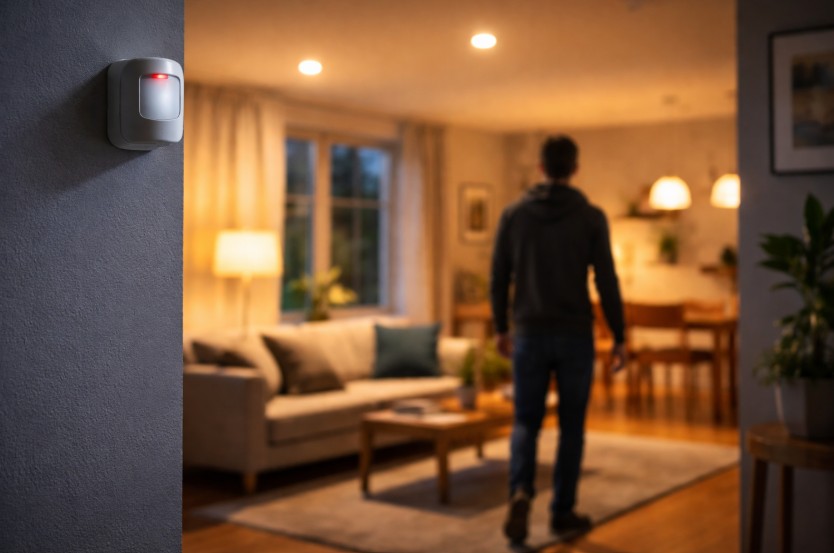
Motion-activated lighting is often held up as one of the most practical and satisfying outcomes of smart home automation. When it works well, lights respond instantly, switches disappear into the background, and daily routines become almost invisible. When it works poorly, however, motion lighting quickly turns from convenience to constant irritation. Lights switch on at the wrong time, turn off when someone is still in the room, or behave unpredictably enough that family members lose trust in the system entirely.
The difference between those two outcomes rarely comes down to hardware quality alone. More often, it is the result of subtle design mistakes in how motion sensors, automations, and lighting logic are combined. These mistakes are easy to make, especially when setting up a system room by room over time. What follows is a deep dive into the most common pitfalls that undermine motion-based lighting systems, along with practical strategies to avoid them. The goal is not to overengineer the home, but to create motion lighting that feels natural, reliable, and almost forgettable in daily use.
Choosing the Wrong Type of Motion Sensor for the Room
One of the most fundamental errors in motion lighting design is assuming that all rooms benefit from the same type of motion sensor. In practice, the simplicity or intelligence of a sensor must match the way a space is used.
Basic motion sensors that operate independently of a smart platform can be extremely effective. They are fast, reliable, and require almost no configuration. In transitional spaces such as pantries, closets, and laundry rooms, this simplicity is an advantage. These are rooms where occupants typically spend only a few minutes, often with hands full, and expect the lights to turn on instantly and turn off shortly after leaving.
Problems arise when these same sensors are placed in rooms where people sleep or rest. Bedrooms, guest rooms, and multipurpose rooms that may become bedrooms later require more nuanced control. A simple motion-triggered switch cannot distinguish between someone entering the room intentionally and someone shifting position during sleep. The result is lighting behavior that feels intrusive, particularly at night.
The key takeaway is not that basic motion sensors are flawed, but that they must be confined to spaces with predictable, short-term occupancy. Any room where someone may remain still for extended periods, or where lighting changes would be disruptive, demands a smarter approach.
Relying on Motion Sensors Alone to Turn Lights Off
Motion sensors excel at detecting entry and movement, but they are far less reliable at determining continued presence. This limitation becomes apparent in rooms where occupants tend to sit still, such as kitchens during food preparation, offices during focused work, or living rooms during quiet activities.
Passive infrared sensors detect changes in heat across their field of view. When a person stops moving significantly, the sensor may conclude that the room is empty, even when it is not. This leads to lights switching off unexpectedly, often at the worst possible moment.
Several alternative presence detection methods can help address this issue. Sensors based on millimeter wave technology can detect extremely subtle movements, including breathing. This makes them well suited for continuous presence detection, although availability and cost can be limiting factors. Other approaches use environmental signals such as Wi-Fi or ultrasound to infer occupancy, with varying degrees of reliability.
A particularly effective strategy is to separate the logic for turning lights on from the logic for turning them off. Motion sensors can be used for instant activation when someone enters a space, while a different presence-detection mechanism determines when the room is truly empty. This layered approach reduces false negatives and makes lighting behavior feel more intelligent.
Turning Lights Off Too Abruptly
Even with improved presence detection, the way lights turn off matters. An abrupt transition from fully lit to complete darkness can be jarring and inconvenient, especially if the system makes a wrong decision.
Gradual fade-outs offer a simple but powerful improvement. Instead of switching lights off instantly, the system dims them over a short period. This provides a visual warning that the automation is about to turn the lights off, giving occupants time to move or wave a hand to re-trigger detection if they are still present.
This technique does not require advanced sensors or complex logic. It relies on human perception and reaction time to compensate for occasional sensor inaccuracies. For shared households, it also communicates system behavior clearly, reducing confusion and frustration.
Mismanaging Multiple Motion Sensors in a Single Area
Larger rooms, garages, and long hallways often require more than one motion sensor to achieve adequate coverage. While adding sensors improves detection, it also increases the risk of logical errors in automation rules.
A common mistake is allowing any single sensor to turn the lights off independently. In such setups, one sensor may lose sight of an occupant while another still detects movement. If the automation responds to the first sensor alone, the lights may turn off even though the space is still occupied.
The correct approach is to treat multiple sensors as a collective input. Lights should only turn off when all relevant sensors report no motion. This requires careful configuration but dramatically improves reliability. It also scales well, allowing additional sensors to be added without increasing the likelihood of false shutoffs.
Positioning Motion Sensors Incorrectly
Sensor placement has a significant impact on detection speed and consistency. Many users instinctively point motion sensors toward doorways, assuming that detecting someone walking straight toward the sensor is optimal. In reality, most motion sensors are more sensitive to movement across their field of view than movement directly toward them.
Positioning sensors so that occupants walk laterally across the detection zone increases the likelihood of quick and reliable activation. Mounting sensors slightly off to the side and at an angle often yields better results than placing them directly in front of an entrance.
Height and orientation also matter. Sensors mounted too high or too low may miss subtle movements or detect unintended activity. Fine-tuning placement is often more effective than adjusting sensitivity settings, and it pays dividends across the entire system.
Ignoring Time-of-Day Context in Automation Logic
Lighting needs change throughout the day, yet many motion lighting systems apply the same rules at all times. This one-size-fits-all approach leads to unnecessary friction.
During daylight hours, longer delays before turning lights off make sense. Natural light may fluctuate, and occupants may move less while engaged in tasks. At night, however, shorter delays are preferable to avoid disturbing others and to conserve energy.
By creating separate automation rules for different times of day, motion lighting becomes more adaptive. Kitchens, for example, benefit from extended on-times in the afternoon and early evening, while nighttime behavior can be optimized for brief, low-impact illumination. This temporal awareness transforms motion lighting from a blunt tool into a responsive system that aligns with household rhythms.
Allowing Motion Lights to Activate When They Should Not
Few things undermine trust in automation faster than lights turning on at inappropriate moments. Watching a movie, taking a nap, or resting during the day are all scenarios where unexpected lighting changes feel intrusive.
Preventing these situations requires context-aware conditions in automation logic. Activity indicators such as television usage, pressure sensors on furniture, or ambient light levels can be used to determine whether motion-triggered lighting should be suppressed.
Manual overrides are equally important. A simple switch or software toggle that disables motion lighting for a room provides users with immediate control. This flexibility ensures that automation enhances comfort rather than dictating behavior.
Removing Physical Control in Favor of Pure Automation
Fully automated lighting systems often promise a switch-free future, but removing physical controls entirely introduces risk. No matter how well-designed an automation system is, failures and edge cases are inevitable.
Providing a physical way to turn lights off ensures that occupants are never trapped by automation logic. Smart light switches offer a balanced solution, combining automation with tactile control. They allow users to override behavior instantly without reaching for a phone or navigating an app.
This hybrid approach acknowledges that automation should support human preferences, not replace them entirely. Physical controls act as a safety net, preserving usability even when the system behaves unexpectedly.
Balancing Complexity With Long-Term Reliability
Designing effective motion lighting systems requires more thought and experimentation than simply installing sensors and writing basic rules. It involves understanding human behavior, room usage patterns, and the limitations of sensing technologies.
The effort, however, pays off over time. Systems that are carefully tuned become effectively invisible, blending into daily life without drawing attention to themselves. Complaints diminish, manual overrides become rare, and the household adapts naturally to the automation rather than working around it.
Motion lighting is not about chasing novelty or showcasing technical prowess. It is about creating environments that respond intuitively and respectfully to the people who inhabit them. Avoiding the common mistakes outlined above moves smart homes closer to that ideal, turning motion lighting from a source of frustration into one of the most quietly successful applications of home automation.