OSHA has no exoskeleton-specific standard. Not a proposed one, not a draft — nothing. Employers evaluating these devices in 2026 are working entirely off the General Duty Clause and a scattering of state-level fact sheets. The regulatory vacuum hasn’t slowed adoption; it’s just made the injury-cost math the only real evaluation criteria that exists.
The Texas Department of Insurance’s exoskeleton safety fact sheet, published October 2025, states plainly that OSHA has no specific exoskeleton standard — employers are directed instead to existing lockout/tagout, machine-guarding, and general ergonomic hazard rules. OSHA’s own ergonomics guidance classifies exoskeletons as a potential engineering control under the hierarchy of controls rather than as a defined equipment category, which means there’s no certification checklist to hand a vendor. What fills the gap is ASTM International’s F48 committee, which has drawn roughly 90 member organizations specifically to build exoskeleton standards from scratch — work that’s still in progress, not finished.
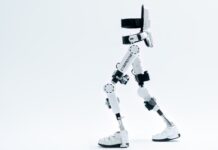
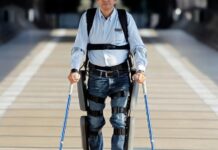
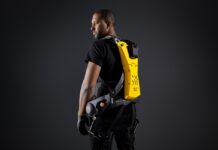
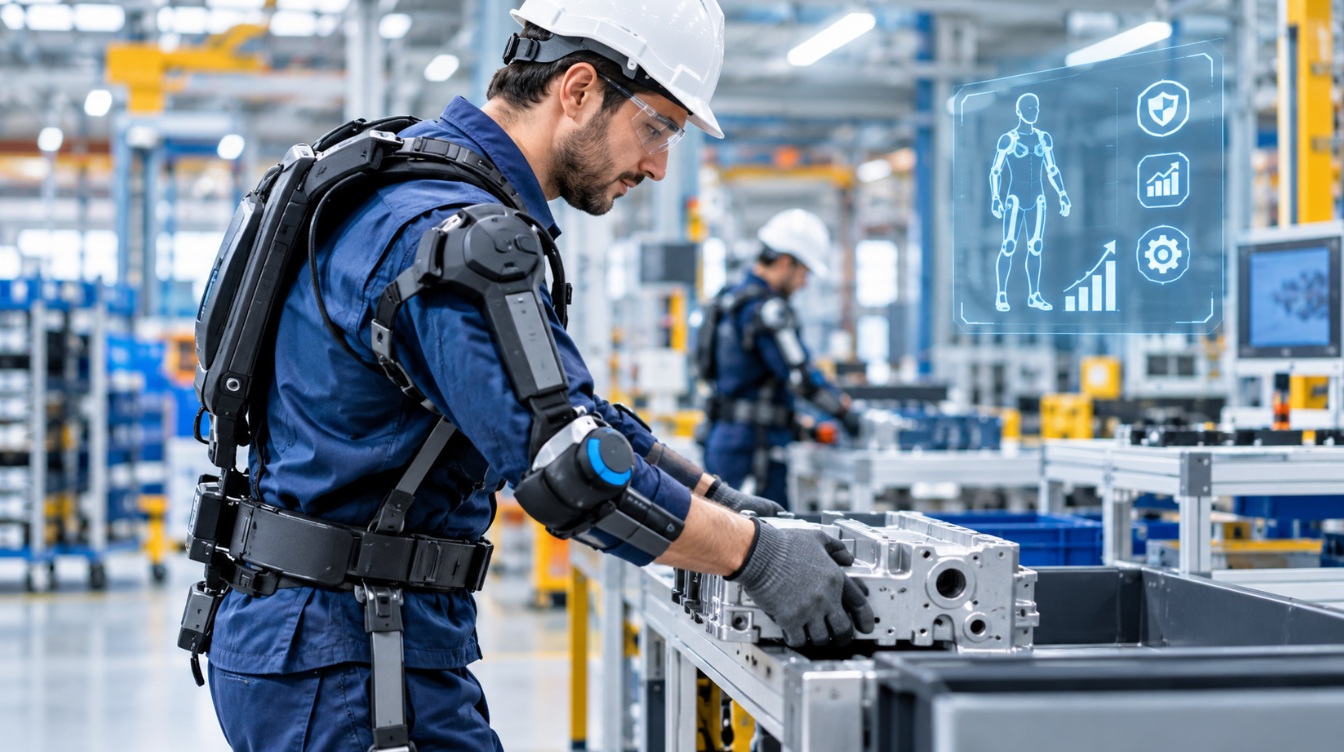
That regulatory ambiguity makes a purchase decision harder than it should be, because “exoskeleton” now covers four genuinely different product categories aimed at four different injury types, at price points from under $4,000 to over $100,000. Buying the wrong category for your actual injury pattern is the most common way these programs fail. The seven devices below are grouped by what they actually protect — full-body powered lift assistance, shoulder and overhead-arm support, lower-back support, and hand/grip support — with the injury-cost data that makes each category’s ROI case.
Full-Body Powered: For Repetitive Heavy Lifting
1. German Bionic Exia / Apogee Ultra
German Bionic’s newest system, unveiled at CES 2026, delivers up to 38 kg (84 lbs.) of dynamic lift support per movement, powered by what the company calls Augmented AI — a system trained on billions of real motion data points rather than simulation, adjusting its assistance profile to each wearer’s movement pattern. The company sells through a robotics-as-a-service and software-as-a-service model rather than a straight equipment purchase, and reports that customers using its exoskeletons have seen a 31% drop in sick leave. Musculoskeletal disorder claims average more than $67,000 per claim for U.S. employers, which is the number German Bionic’s sales pitch is actually built around — not the lift rating.
2. Sarcos Guardian XO
At an estimated purchase price of $100,000–$150,000, or $5,000–$8,000/month as Exoskeleton-as-a-Service, the Guardian XO is the most expensive device on this list by a wide margin — and Sarcos makes no attempt to justify that price on lift capacity alone. The company’s own ROI framing is explicit: the suit pays for itself if it prevents just two to three serious back injuries a year, against an average injury cost of $40,000–$80,000 including workers’ comp and lost time. It lifts and manipulates loads up to 200 lbs. using more than 120 onboard sensors, and Sarcos claims a 3–5x throughput improvement over manual handling for heavy material tasks — the EaaS pricing exists specifically so operators can test that claim before committing six figures.
Shoulder & Arm: For Overhead and Repetitive-Reach Work
3. Comau MATE
The Comau MATE (Muscular Aiding Tech Exoskeleton) is an active shoulder support device that transfers roughly 30% of muscular burden from the shoulders to the pelvis across seven adjustable assistance levels, weighing about nine pounds and priced around $5,700. It’s already in volume use at Stellantis (formerly FCA) plants across Europe and Asia-Pacific — one of the few devices on this list with genuine multi-year, multi-site deployment history rather than pilot-program data.
4. Ekso Bionics EksoVest
The passive, unpowered EksoVest uses spring assistance to support arm elevation for overhead work, and has the deepest published performance data of any device here: an 83% reduction in shoulder muscle activation and a 54% reduction in fatigue reports among Ford assembly workers, plus deployment across Boeing’s twin-Dreamliner factories following trials the United Automobile Workers union paid for directly because it wanted independent injury data. At roughly $3,800–$7,500 depending on configuration, the ROI math is almost embarrassingly simple: a $5,000 vest lasting three years works out to about 12 cents per hour per employee — cheaper than a pair of disposable work gloves.
Back: For Bend-and-Lift Cycles
5. Ottobock Paexo Back
Ottobock’s Paexo Back is described in independent industry rankings as the most clinically validated passive back exoskeleton currently in production, using a rigid frame and hip-pivot springs to redistribute lumbar load onto the hips and thighs during forward bending. At 1.6 kg with no battery required, it’s CE certified and FDA registered — meaningful in a market where most competitors carry no regulatory registration at all, since none is currently mandated. Devices in this passive-back category generally run $2,800–$5,000 and, per the same industry analysis, pay for themselves within two years in typical warehouse bend-and-lift environments.
6. HeroWear Apex
HeroWear’s Apex is built as a flexible textile exosuit rather than a rigid frame, and the company has put an unusually specific number behind its ROI claim: in a warehouse worker case study, an 8% productivity improvement let the device pay for itself in under five months, saving roughly $3,900 per worker in the first year. That’s a narrower, more verifiable claim than most exoskeleton vendors make — most published ROI numbers in this category describe injury-cost avoidance, which is harder to attribute cleanly; HeroWear’s is a productivity number measured directly against the device’s cost.
Hand & Grip: For Repetitive Strain Injuries
7. Skelex Ironhand
Ironhand began as a General Motors and Bioservo collaboration and won a NASA Commercial Invention of the Year award, but in June 2024 Skelex acquired the rights to develop and sell it, with Bioservo retreating to focus on its medical-market Carbonhand product. The current version is a powered soft glove — sensors on all five fingers detect grip intent and a motor-driven “artificial tendon” system adds force, weighing under 3 kg including the backpack-mounted power unit. It’s the only device on this list aimed specifically at hand and forearm strain rather than back, shoulder, or full-body load, and includes built-in HAL-TLV and DUET ergonomic risk reporting — turning every shift into logged exposure data rather than a subjective fatigue complaint.
Bottom Line
The four categories above aren’t interchangeable, and the ROI numbers only hold up when the device matches the actual injury pattern: a $150,000 full-body powered suit solves a different problem than a $3,800 passive vest, and buying the wrong one wastes money whether or not the device itself works as advertised. What’s consistent across every device here is that vendors are increasingly comfortable publishing specific numbers — dollar figures, percentage reductions, payback periods — rather than leaning on “AI-powered” as the selling point by itself. That’s a reasonable proxy for how the category is maturing, in the absence of a formal standard to measure it against.
Until ASTM’s F48 committee finishes its work, the practical due-diligence step is the same one German Bionic, Sarcos, and HeroWear are all implicitly asking buyers to do: run the specific injury-cost math for your own facility rather than trusting a vendor’s category-wide average.