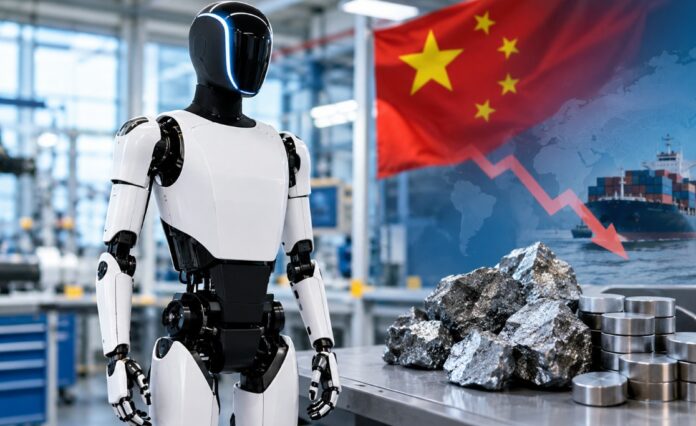
Elon Musk has promised thousands of Optimus robots in a single year. He has also promised a million a year by around 2030. Neither number is close to reality, and the gap between those promises and the factory floor is where the interesting story lives.
The latest excuse is a physical one, not a software one. Magnets. Specifically, the rare-earth magnets that sit inside every joint motor of a humanoid, and which China has been squeezing through export controls. If you follow robotics hardware, you already know why that matters. If you follow Tesla timelines, you know it’s the newest entry in a long list of reasons a robot didn’t show up when promised.
This piece treats each missed date as a data point. Then it asks a blunt question: what would a crowd of people with money on the line say about the next one?
Why a handful of magnets can stall a humanoid
A humanoid robot is mostly actuators. Dozens of them. Each one wants a compact, powerful motor, and the best compact motors use neodymium-based permanent magnets. China dominates the processing of those materials, which is why export restrictions bite so hard.
Musk said as much on the Q1 2025 earnings call, when he confirmed that China’s rare earth restrictions had hit Optimus production and that Tesla needed licences to ship magnets out of the country. Not a rumour. The CEO, on the record, in public.
That’s the part worth sitting with. A robot that costs tens of thousands of dollars to build can be blocked by components worth a few dollars each. No amount of clever AI helps if the wrist motor has no magnet in it.
For anyone tracking the wider sector, the same exposure shows up in Chinese hardware vulnerabilities and supply chain security, where dependence on a single country’s components keeps surfacing as the structural weak point.
A short history of missed Optimus dates
The pattern is consistent enough that you could almost chart it.
The first prototype appeared in late 2022, famously after a person in a robot suit danced on stage the year before. Production targets followed. Then they slid. Then they were restated with fresh confidence.
By mid-2026, the slippage had become its own genre of coverage. When the Optimus V3 reveal and the Fremont production timeline moved again, Elon Musk shut down the “4D chess” theory that the delays were intentional. Read that again. He had to publicly deny that the slowness was a strategy. Now the magnet export curbs are being blamed for months of lost time, with a 2027 launch the current target.
I’ll be honest about my read here. Every one of these slips is individually explainable. Magnets, tooling, a redesigned hand, a software rebuild. Taken together, they say something simpler: Tesla’s robot dates are aspirations, and aspirations get discounted.
The question is by how much.
Where traders put a price on the delay
Here’s where the story gets more useful than another round of “Musk says” headlines.
When an announcement is cheap, it tells you little. When someone has to put money behind a claim, it tells you more. That’s the whole logic behind letting a crowd bet on outcomes, and it’s why timeline questions like “will Optimus be sold to the public before a given date” have become a natural fit for prediction market apps.
The mechanics are simple. A contract pays out if an event happens by a stated date. The price of the contract reads as a probability. If a “yes” share trades at 22 cents, the crowd is saying roughly a 22% chance. Each new delay announcement tends to knock that number down, sometimes sharply, sometimes barely, and the size of the move is itself informative.
That’s what I find compelling about this approach for hardware stories. A press release can’t tell you how much a magnet shortage should lower your confidence. A market can, because every trader has to decide for themselves whether the news was already priced in. If the price barely moves after a Musk statement, the crowd had already assumed the slip.
Note what I’m not claiming. I haven’t tracked a single Optimus contract through a full delay cycle, so I can’t hand you a clean before-and-after chart. What I can say from watching event markets generally is that headline-driven spikes fade fast, while repeated misses grind the price down in a steady staircase.
Reading the odds without fooling yourself
A market price is a useful signal. It is not a crystal ball, and there are a few traps worth naming.
First, thin markets lie. A contract with a handful of traders can swing on one large order, so a dramatic move on low volume deserves suspicion. Second, the wording of a contract decides everything. “Production begins” and “available for public purchase” are very different finish lines, and Tesla has a habit of announcing the first long before the second.
Third, and this is the one people forget, a probability is not a promise. A 30% chance means the event fails seven times out of ten and still isn’t a surprise on the other three.
There’s also a regulatory dimension. Event-contract platforms operate in a legal gray zone in parts of the US, a tension that recent reporting on how Kalshi and Polymarket work and where they sit with regulators lays out plainly. If you’re reading odds for research rather than trading, none of that bothers you. If you’re considering putting money down, it should.
What the magnet story means for robotics buyers
Strip away the market angle and the operational lesson is the same one procurement teams keep relearning. A vendor’s delivery date is a claim, and claims need a discount rate.
If you’re evaluating humanoids for a warehouse or a line, the useful questions are boring ones. Where do the actuators come from? Does the vendor hold magnet inventory or depend on spot supply? What happens to your rollout if a licence is delayed by a quarter?
Safety certification adds another layer of schedule risk, which is why the coverage of ISO safety standards for humanoid robots matters as much to a buyer as any demo reel. A robot that works but can’t be certified still doesn’t ship into your building.
The broader funding picture reinforces the point. Money is pouring in, with humanoid companies reportedly raising billions across dozens of rounds this year. But capital doesn’t conjure magnets. It buys engineers and factories, and both take time.
FAQ
Why are rare-earth magnets so important to humanoid robots?
Every joint needs a compact, powerful motor, and the strongest small motors use neodymium-based permanent magnets. A humanoid has dozens of actuators, so it consumes a lot of them. China controls most of the processing, which is why its export curbs can stall production quickly.
Has Tesla confirmed the magnet shortage affected Optimus?
Yes. Musk said on the Q1 2025 earnings call that China’s rare earth restrictions hit Optimus production and that Tesla needed export licences for the magnets. He has since linked further delay to the same constraint, with a 2027 launch now the target.
How does a prediction market price a delayed product launch?
A contract pays out if the event occurs by a set date, and its trading price reads as an implied probability. When new delay news arrives, traders reprice, so the size of the move shows how surprised the crowd actually was.
Can I trust the odds on an Optimus contract?
Treat them as one signal, not proof. Thin markets can swing on a single order, and contract wording matters enormously. “Production begins” and “sold to the public” resolve very differently, so read the exact terms before drawing conclusions.
Where this leaves the Optimus timeline
The magnet shortage is real, and it’s a fair reason for delay. It’s also the latest in a series, and a series is what a market learns to price in.
My take: treat any Optimus public-sales date as a soft target until magnet licences and a working production line are both confirmed in writing. The crowd’s skepticism, whatever the exact number, is probably better calibrated than the keynote.
Gambling involves risk. Please play responsibly and only wager what you can afford to lose. If you feel gambling is becoming a problem, visit BeGambleAware.org or call 1-800-GAMBLER.