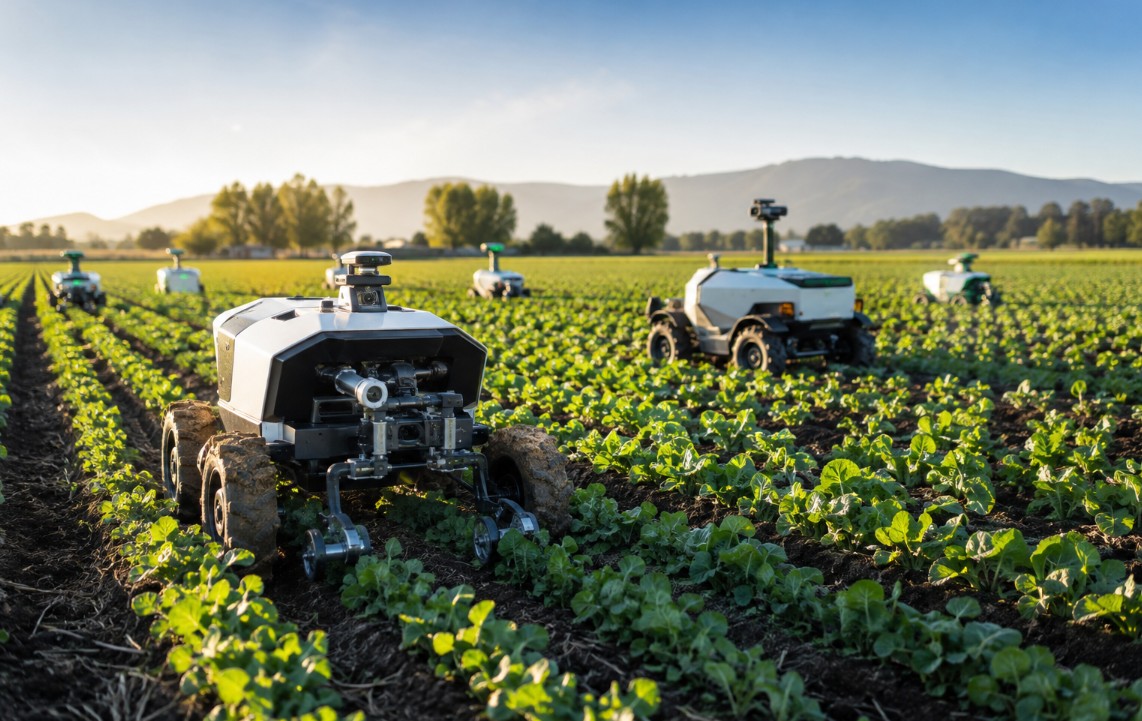
A $500,000 laser weeder sounds like a hard sell to a produce grower — until one customer says it cut annual weeding costs from over $1 million to under $200,000. That gap between sticker price and field economics is the real story of agricultural robotics in 2026.
Jordan Hungenberg, co-owner of Hungenberg Produce Co., didn’t buy a Carbon Robotics LaserWeeder because it looked impressive at a trade show. He bought it because his weeding bill was running past $1 million a year and dropped to somewhere between $100,000 and $200,000 after deployment. That’s the kind of number that gets a $500,000 machine approved by a farm’s finance department.
The marketing language around agricultural robotics still leans on words like “autonomous” and “unmanned.” The field reality is more qualified: GUSS sprayers run driverless rows but are supervised by one operator managing up to eight machines from a laptop; Carbon Robotics’ Large Plant Model still routes edge cases to human review; FarmWise sells its Titan as a labor service, not a set-and-forget appliance. The technology has moved past demo-day novelty, but “autonomous” in 2026 usually means “closely supervised at scale,” not “unattended.”
This list covers eight robots and platforms — from laser weeders to a genuinely new category of robot dogs — that are operating on commercial farms right now, with real pricing, deployment numbers, and grower feedback attached to each one.
1. Carbon Robotics’ LaserWeeder Cut One Grower’s Weeding Bill by 80%
The LaserWeeder G2 is now operating across hundreds of farms in 15 countries, using a Large Plant Model trained on roughly 150 million labeled plants to identify and thermally eliminate weeds without touching the soil or crop. At around $500,000 per unit — or roughly $13,889 a month on lease — it’s priced for large-scale vegetable and specialty-crop operations, not hobby farms. Beyond Hungenberg’s cost reduction, grower Gaël Dube-Laberge of Vegpro reported weeding labor cut by more than half after one season. In 2026 the company added Carbon ATK, an autonomous tractor kit that retrofits existing Deere 6R/8R-series tractors rather than requiring a dedicated chassis — a sign the company is trying to lower the adoption barrier below the flagship’s price tag.
2. GUSS Autonomous Sprayers Have Logged Half a Million Driverless Hours
GUSS Automation’s orchard and vineyard sprayers use GPS and LiDAR to run rows without a driver in the cab, and the fleet has now deployed more than 250 machines, sprayed over 1 million hectares, and logged 500,000-plus autonomous hours. A single operator can supervise up to eight units remotely — the “autonomous” claim holds for the driving task specifically, not for the operation as a whole. Following its joint venture with John Deere, GUSS is now integrating Ouster’s Rev8 digital LiDAR — announced in August 2026 — specifically because orchard sensor packages have to survive dust, chemical spray, and heat cycles that don’t show up in a controlled demo.
3. FarmWise Turned Weeding Into a Per-Acre Service Instead of a Capital Purchase
Rather than selling the Titan FT-35 outright — list price around $350,000 — FarmWise runs a robot-as-a-service model: the company supplies the machine and technical staff and charges growers per acre, with pricing that varies by weed density. Braga Fresh has run the Titan across organic romaine, celery, cauliflower, cabbage, and broccoli. The RaaS structure matters as much as the robotics: it removes the six-figure capital decision that keeps a lot of mid-sized farms out of the LaserWeeder or Titan-purchase conversation entirely.
5. Verdant Robotics’ SharpShooter Beat Broadcast Herbicide on Yield, Not Just Chemical Savings
Most weeding-robot pitches lead with chemical reduction. Verdant Robotics leads with yield: field trials run with Rutgers New Jersey Agricultural Experiment Station and Cornell AgriTech found the SharpShooter’s AI-targeted weed control matched broadcast herbicide application while producing higher yield at both 40 and 70 days after planting. The company’s Spraybox platform combines weeding, fertilizing, and data collection in a single pass and is marketed as cutting chemical use by up to 99% — the kind of number that needs the Rutgers/Cornell trial behind it to be credible rather than promotional.
6. AgriPass Raised $7.5 Million to Make Weeding Judgment-Based, Not Just Mechanical
AgriPass’s $7.5 million seed round, led by Harbor Venture Consulting and announced March 5, 2026, is funding its RHIC platform — Robot of Human Inspired Cultivation — which pairs computer vision with contextual AI to decide how and where to cultivate, rather than executing a fixed mechanical pattern. The company also picked up $1.7 million in non-dilutive grants from the Israeli Innovation Authority and is projecting over $1 million in contracted 2026 revenue from existing EU and U.S. deployments. Its partnership with Italian OEM FYELD Group is the more consequential detail — it means AgriPass’s decision-making layer will ship embedded in someone else’s machinery, not just as a standalone robot.
6. Naïo’s Ted Cut One Vineyard’s Tractor Passes in Half
Naïo Technologies’ Ted is described by the company as the only fully autonomous straddling robot on the vineyard market, able to lift up to 600 kg and weed roughly 6.5 hectares a day on a single charge, weighing significantly less than conventional tractors to limit soil compaction. Gabriel Demarco, winemaker at Canada’s Cave Spring Vineyard, said Ted let his team cut tractor passes in half. Naïo now has more than 350 robots — spanning Ted, the smaller Oz, and two other models — deployed across five continents, giving it one of the longer field-hour track records in the category.
7. ecoRobotix’s AVO Cuts Herbicide Volume by 90% Through Per-Weed Dosing
Instead of eliminating chemicals entirely, ecoRobotix’s AVO applies a micro-dose of herbicide to each individual weed it identifies, rather than spraying an entire bed — a design choice co-founder Steve Tanner drew directly from watching hand-weeding on his family’s Swiss sugar beet farm. The approach lets growers cut herbicide volume by roughly 90% while still using conventional chemistry, which sidesteps some of the crop-damage risk that comes with a fully mechanical weeder. The company’s follow-on ARA platform pushed precision further, applying treatment in 6×6 cm intervals across more than 50 identifiable weed species, on the back of $52 million in total funding.
8. Robot Dogs Are Starting to Scout the Rows Drones and Wheeled Robots Can’t Reach
The most genuinely new item on this list isn’t a weeder — it’s a scout. At the Ottawa Valley Farm Show, agronomist Andrew Lemke ran a Unitree Go2 quadruped through corn rows, where its camera captured roughly 2,000 images a minute for weed mapping — a job Lemke argues legged robots handle better than drones (which struggle at ground level) or wheeled units (which struggle in uneven, root-strewn rows). Startup Frutas AI has gone further, building a purpose-built “Agronomist Robot Dog” that autonomously scouts orchard rows, spot-checking crops under five feet tall and returning to a charging dock to upload data. The category is viable now largely because hardware costs collapsed — general-purpose quadrupeds have dropped from roughly $74,500 to $1,600–$2,800, low enough that repurposing one for crop scouting is a reasonable experiment rather than a capital project.
Bottom Line
The gap between “autonomous” as a marketing word and “autonomous” as a field reality hasn’t closed in 2026 — it’s just become better documented. Every platform on this list that claims full autonomy still leans on remote supervision, human review of edge cases, or a service model that bundles in staffing. What has changed is that growers now have real cost data to weigh against that supervision overhead: Hungenberg’s weeding-cost drop, GUSS’s 500,000 supervised-autonomous hours, Verdant’s yield data against broadcast herbicide. That’s a more useful basis for a purchase decision than another autonomy demo.
For a grower evaluating this category in 2026, the practical filter isn’t “is it autonomous” — it’s “what does the supervision actually cost, and does the per-acre or per-machine economics still work once that’s counted in.” On the evidence here, for a growing list of specialty-crop operations, it does.