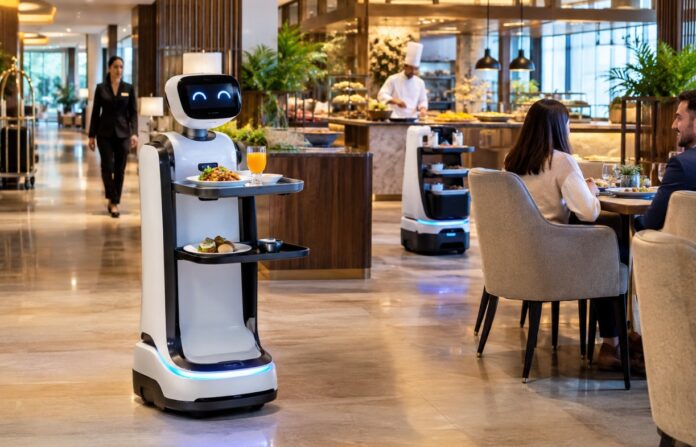
A German restaurant in Sanford, Florida is leasing a cat-faced food runner for $600 a month on a three-month trial. A Shanghai manufacturer has shipped more than 100,000 service robots into 60-plus countries. Both of those are the same category of technology — which says something about how far “service robot” has actually spread in hospitality by 2026.
Hollerbach’s German Restaurant in downtown Sanford started leasing a Pudu BellaBot this month specifically to solve a bottleneck during peak service: bartenders and servers leaving their stations to run food, letting meals cool before they reached the table. Owner Theo Hollerbach calls it his “horizontal elevator,” and he’s paying $600 a month to find out if a three-month trial earns a permanent spot on the floor. That’s the small end of this market. At the other end, Keenon Robotics alone has shipped more than 100,000 units across 60-plus countries and holds the number-one global market share in commercial service robots for a third consecutive year, per IDC.
What connects a single-location trial and a six-figure global fleet is that both are buying the same basic proposition: a specific, narrow task handled consistently, at a lower and more predictable cost than the labor it replaces. The eight robots below span that full range — front-of-house service, room delivery, luggage handling, cleaning, and one genuinely experimental category — grouped by what they actually do rather than by brand size.
Front-of-House Service: Food Running, Bussing, and Drinks
1. Bear Robotics Servi Q and Servi Plus — Built for Floor Plans Robots Used to Rule Out
Bear Robotics, now 51%-owned by LG Electronics, unveiled Servi Q at the May 2026 National Restaurant Association Show specifically to solve the problem that kept robots out of smaller restaurants: tight aisles. Developed with SoftBank Robotics, Servi Q navigates 18-inch passages and simply reverses rather than attempting a three-point turn when a corridor is too narrow to turn around in. The company doesn’t publish list prices, but RaaS plans reportedly start around $999/month, and a 61-restaurant pilot at Chili’s — where staff nicknamed the robot “Rita” — found workers increasingly using it for food running, bussing, and hosting tasks rather than treating it as a novelty.
2. Pudu BellaBot — The Most-Deployed Restaurant Robot, From IHOP to a Single German Restaurant in Florida
Pudu’s cat-faced BellaBot is, per industry integrator RobotLAB, the single most recognizable restaurant robot in the category, with tens of thousands of units running in dining rooms across 60-plus countries at brands including KFC, Pizza Hut, Carrefour, and Jollibee. Pricing runs $15,000–$16,000 to buy or roughly $335–$409/month on a lease, which is exactly the range that let Hollerbach’s test one at $600/month without a capital commitment. The spread between a Fortune 500 drive-thru chain and a single independent restaurant running the identical hardware is the clearest evidence in this list that the category has actually matured past pilot-program pricing.
3. Richtech Robotics ADAM — From Stadium Bars to a Times Square Storefront
ADAM, Richtech’s dual-arm “Automated Dual Arm Mixologist,” has moved well beyond its original café-barista role: it’s now serving drinks at Las Vegas’s T-Mobile Arena and the Texas Rangers’ Globe Life Field (its 10th installation), pouring coffee and boba at a Walmart location, and greeting shoppers at a Times Square retail storefront where it served its first coffee to Shaquille O’Neal in April 2026. Richtech is Nasdaq-listed (RR), and its filings show the economics are real rather than purely promotional: one 25-unit, 60-month event-leasing contract was worth $5.25 million. Nvidia’s Isaac Sim let Richtech train ADAM’s pour technique in a digital-twin bar before it ever served a real drink.
Room Delivery & Luggage: Replacing the Walk, Not the Judgment
4. Relay Robotics’ Relay and Relay2 — Over One Million Hotel Deliveries and a 98% Success Rate
Relay Robotics (formerly Savioke) has completed more than one million hotel deliveries globally, and Marriott’s original 2014 Aloft “Botlr” pilot — the first widely publicized US hotel robot deployment — recorded a 98% delivery success rate, enough to drive chain-wide expansion. The current Relay2 carries double the payload of earlier models and integrates with elevator systems from Otis, Schindler, TK Elevator, Mitsubishi Electric, and KONE — necessary infrastructure, not a nice-to-have, since a delivery robot that can’t reliably call and ride an elevator is an expensive cart. Deployments span Marriott, Hilton, Holiday Inn Express, and Crowne Plaza, leasing at roughly $1,500–$2,000/month.
5. Keenon’s W3/BUTLERBOT — The Backbone of a 10,000-Hotel, 25,000-Restaurant Footprint
Keenon’s delivery line is the volume leader behind the company’s headline numbers: deployed in more than 10,000 hotels and 25,000 restaurants across Asia-Pacific, Europe, and North America, with a cooperation agreement with Wyndham Hotel Group signed in 2023 that put BUTLERBOT units across Wyndham properties in multiple markets. At Hong Kong’s Shangri-La, Keenon runs six different robot types across eight units inside a single property — a useful illustration that “a hotel’s service robot” is increasingly a small fleet handling different jobs, not one general-purpose unit. Pricing for the hardware runs $8,000–$22,000 depending on model.
6. YOTEL’s YOBOT — A Novelty Robot That Became a Chain Standard
YOBOT started as a single-hotel gimmick at YOTEL New York Times Square — a 20-foot robotic arm that can lift 500 pounds and process around 300 pieces of luggage on a busy day across 150 storage bins. More than a decade after that debut, YOTEL is now specifying YOBOT as a standard feature at new openings rather than a one-off: the Bangkok property (opened late 2025/2026) and upcoming Belfast and Kuala Lumpur hotels all list a YOBOT installation alongside self-service check-in as part of the standard brand package. That’s the real signal here — not that the robot works, which has been true since 2011, but that it’s graduated from flagship-property showpiece to a line item in a standard hotel-opening checklist.
Cleaning: The Least Glamorous, Most Mature Category
7. Gausium’s Vacuum 40 — 40,000-Plus Units and a Four-Year-Old Case Study to Prove It
Gausium has deployed more than 40,000 autonomous cleaning robots across 70-plus countries, and its hospitality case data goes back further than almost anything else on this list: Chinese hotel chain Hanting has run a Vacuum 40 Diffuser unit on daily lobby and five-floor corridor cleaning since February 2022 — a genuine multi-year production deployment rather than a pilot. The current Vacuum 40 combines vacuuming, sweeping, and dust-mopping with 24 kPa suction and runs $42,000 to purchase or $881/month via RaaS, deployed at properties including Four Seasons and Hyatt locations through integrator RobotLAB. Cleaning robots rarely make headlines the way food-running or bartending robots do, but the deployment numbers here are larger and the case-study history longer than any guest-facing robot on this list.
Experimental: The Category Still Finding Its Job
8. Keenon’s XMAN-R1 Humanoid — Pouring Drinks, Not Yet Running a Hotel
Keenon itself is candid about where this one stands: the company’s own assessment, cited at its GCS 2026 event, puts humanoid robots’ current “mind age” at roughly three years old, with true general-purpose deployment still at least five years out by its own estimate. At the 2026 World AI Conference, Keenon showcased the XMAN-R1 handling humanoid-powered coffee service and hotel laundry workflows integrated with its established DINERBOT T9, built on insights from the company’s existing 100,000-plus commercial deployments rather than starting from scratch. It’s included here specifically because Keenon — the company with the deepest deployment data in this entire list — is the one most openly saying the humanoid category isn’t ready for the kind of scale its wheeled robots have already reached.
Bottom Line
The gap between Hollerbach’s $600-a-month trial and Keenon’s 100,000-unit fleet isn’t really a gap in the technology — it’s the same maturity curve viewed from two different points. Front-of-house service and room delivery have reached the stage where a single independent restaurant and a global hotel chain can buy the identical hardware on comparable terms, which is the real marker of a category that’s moved past pilot-program pricing. Cleaning has quietly gone further, with deployment and case-study histories longer than almost anything guest-facing. Humanoids are the one category on this list where the leading vendor is telling buyers, unprompted, not to expect general-purpose deployment yet — which is more useful information than another splashy demo.