A Growth Opportunity Perspective, styled on Frost & Sullivan’s Mobility research format — a market-sizing, vendor-and-OEM-facing analysis. This is not an actual Frost & Sullivan publication.
The automotive industry is undergoing simultaneous disruption across propulsion, software architecture, and autonomy — three transitions that would each individually qualify as generational, now compressed into the same product cycle. Global electric car sales are projected to reach 23 million units in 2026, or roughly 28% of all new car sales, up from 25% in 2025, according to the IEA’s Global EV Outlook 2026. At the same time, the software-defined vehicle (SDV) market — estimated at anywhere from USD 170 billion to over USD 630 billion in 2026 depending on scope — is forecast to grow at a 16%–34% CAGR through the early 2030s across multiple research providers. Autonomous mobility has crossed from pilot to commercial scale: Waymo alone now delivers roughly 500,000 paid rides per week, up tenfold from 50,000 in May 2024.
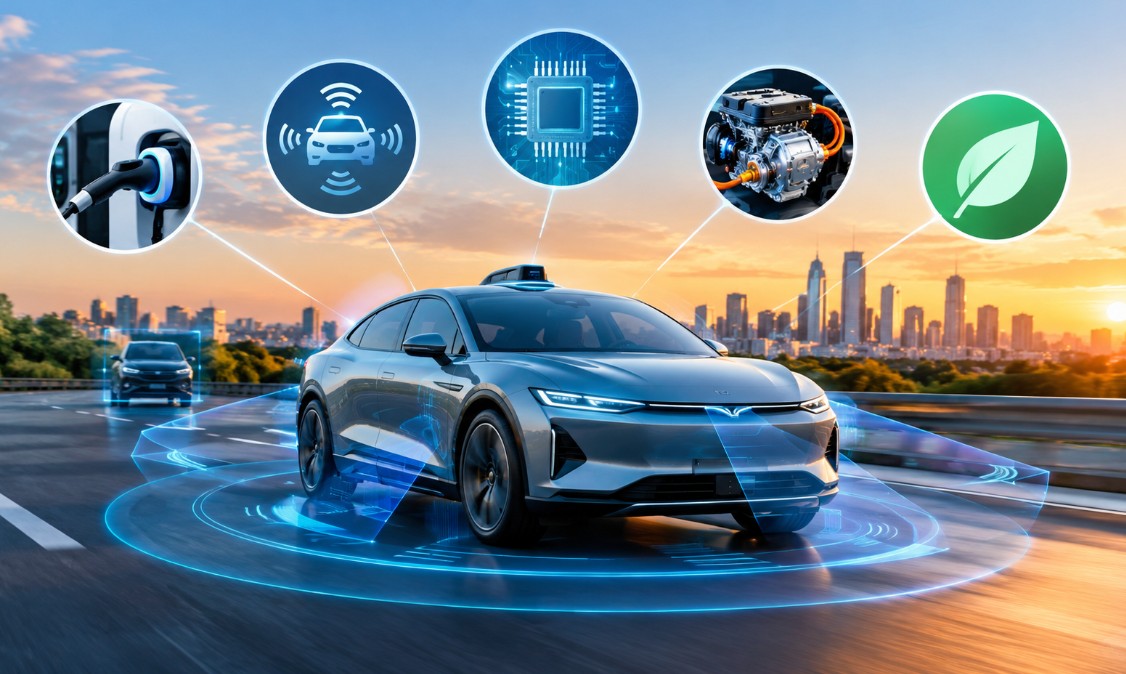
This brief identifies five Growth Opportunities reshaping OEM strategy, supplier positioning, and investment allocation through 2030: (1) software-defined vehicle architecture, (2) autonomous mobility and robotaxi services, (3) next-generation battery chemistry, (4) AI-embedded ADAS and in-cabin intelligence, and (5) vehicle electrification’s second-order infrastructure demand. Across all five, the Strategic Imperative is consistent: technology leadership is shifting away from hardware manufacturing scale and toward software-update velocity, data-driven fleet learning, and regulatory-evidence readiness — a competitive axis most legacy OEMs are still building the organizational capability to compete on.
1. Software-Defined Vehicles
The single most consequential structural change in the industry is the move from hardware-fixed vehicles to software-defined ones — platforms that, like a smartphone, gain functionality after the point of sale via over-the-air (OTA) updates. Market-size estimates vary widely by methodology: MarketsandMarkets places 2026 value at USD 447.55 billion, growing to USD 1.71 trillion by 2035 (16.0% CAGR), while Future Market Insights estimates a considerably larger USD 633.85 billion for 2026 (MarketsandMarkets; Future Market Insights). The dispersion itself is a signal: this is a category still being defined by the market, not yet a mature, standardized segment.
Tesla, BYD, Mercedes-Benz, Zeekr, and Li Auto collectively held 25.9% share of the SDV market in 2025, with Tesla leading individually at roughly 8.5% (Global Market Insights) — a share distribution that favors companies built software-first over legacy OEMs retrofitting software capability onto hardware-first organizations. Asia Pacific is consistently identified as both the largest and fastest-growing SDV region, reflecting China’s manufacturing scale: the IEA notes China produced 12.4 million electric cars in 2024, as reported by Future Market Insights, more than 70% of global EV production.
Strategic Imperative: Legacy OEMs face a structural disadvantage in this category that capital spending alone cannot close — SDV leadership requires centralized computing, zonal E/E architecture, and continuous software-engineering capability that most traditional automakers are still building organizationally, not just technologically.
2. Autonomous Mobility
Autonomous ride-hailing has crossed a commercialization threshold that market-sizing forecasts have struggled to keep pace with. Waymo’s weekly paid trips grew tenfold, from 50,000 in May 2024 to 500,000 by March 2026, and the company has stated a goal of exceeding 1 million weekly rides by the end of 2026 (TechCrunch; Mexico Business News). Waymo served 15 million paid trips in 2025 — more than tripling its 2024 volume — and raised USD 16 billion at a USD 126 billion valuation in February 2026 (Axis Intelligence). Globally, Baidu’s Apollo Go has logged 20 million cumulative rides as of February 2026, putting it ahead of Waymo in raw trip volume despite Waymo’s US commercial lead.
Safety data is emerging as a key competitive and regulatory differentiator, not just a compliance requirement: Waymo reports a roughly 90% reduction in serious-injury crashes across more than 127 million autonomous miles (SQ Magazine). Forecasts for the broader robotaxi market vary substantially — Fortune Business Insights projects the global market reaching USD 96.31 billion by 2034 at a 71.9% CAGR from a base of roughly USD 0.6 billion in 2025, per Axis Intelligence’s synthesis — reflecting the category’s early-stage, low base-value status even as commercial scale accelerates.
Strategic Imperative: The gap between Waymo/Baidu’s commercial scale and Tesla’s more limited driverless deployment (fewer than 25 unsupervised vehicles as of early 2026) illustrates that regulatory-permit accumulation, fleet-learning data volume, and city-by-city operational scaling — not raw AI model capability — are now the binding constraints on robotaxi market share.
3. Next-Generation Battery Chemistry
After more than a decade as a laboratory promise, solid-state and semi-solid battery technology is entering limited production in 2026. Chinese automakers are leading initial rollout: one manufacturer began commercial production of a semi-solid-state battery in 2026 rated for over 620 miles of range, while Stellantis and battery startup Factorial have validated cells with 375 Wh/kg energy density — roughly 25%–90% higher than typical lithium-ion cells (200–300 Wh/kg) — supporting 15–90% charges in 18 minutes (InsideEVs). Toyota, Honda, and Nissan are each targeting solid-state mass production in the 2027–2028 window, while BloombergNEF projects solid-state chemistry will account for only about 10% of global EV and battery-storage demand by 2035 — a reminder that commercialization and market-share capture are following different, slower timelines than headline announcements suggest (InsideEVs).
Strategic Imperative: The realistic near-term opportunity for most market participants sits in semi-solid and hybrid chemistries reaching production now, rather than full solid-state technology still 2–4 years from automaker-stated mass production — vendors and investors overweighting “solid-state” announcements risk mistiming the actual commercialization curve.
4. AI-Embedded ADAS and In-Cabin Intelligence
Advanced driver-assistance systems (ADAS) and AI-powered in-cabin features are cited across multiple market reports as primary drivers of both the SDV and broader connected-vehicle markets, alongside expanding 5G connectivity and centralized vehicle computing (Fortune Business Insights). Tesla’s Full Self-Driving (Supervised) system illustrates the scale this category has reached in deployed form even short of full autonomy: over 10 billion cumulative miles driven (approximately 3.8 billion on city streets) and 1.48 million active FSD subscriptions as of Q2 2026, up 56% year-over-year (The Charge Port).
Strategic Imperative: ADAS and in-cabin AI represent the lowest-regulatory-friction entry point into vehicle autonomy for both legacy OEMs and suppliers — offering a path to accumulate real-world driving data and consumer trust ahead of any move toward full autonomy, mirroring the “low-risk deployment builds trust for higher-stakes categories” pattern also observed in AI-in-healthcare adoption.
5. Electrification’s Second-Order Infrastructure Demand
EV adoption itself remains the foundational disruption enabling the other four. Global electric car sales are projected at 23 million units in 2026 (28% of all new-car sales), following 20.7 million units (over 25% share) in 2025 — a threshold the IEA notes was crossed for the first time that year (IEA). China remains the dominant force: Chinese-made models accounted for over 80% of battery-electric and over 90% of plug-in-hybrid car sales domestically in 2025, and Chinese automakers supplied roughly 60% of EVs sold globally (IEA Global EV Outlook 2026; Al Jazeera/AA). Notably, global EV sales fell 8% year-on-year in Q1 2026, driven by policy shifts in China and the US — even as Europe grew nearly 30% and Asia-Pacific (excluding China) grew 80% — underscoring that the electrification curve, while directionally clear, is not uniformly smooth across markets or immune to policy volatility.
Strategic Imperative: The Q1 2026 sales dip is a reminder that regional policy dependency remains the primary risk factor for electrification-linked technology investment — charging infrastructure, battery supply chains, and software-platform vendors should diversify regional exposure rather than concentrating on any single policy-sensitive market.
Cross-Cutting Strategic Imperatives for Market Participants
For OEMs: The five disruptions above are not independent; they compound. A vehicle that is software-defined, AI-embedded, and electric is a fundamentally different R&D, supply-chain, and go-to-market proposition than a traditional vehicle with electrification added on. OEMs still organized around hardware-cycle timelines face a structural disadvantage against software-first entrants and Chinese manufacturers already operating at electrification-and-software scale.
For suppliers and technology vendors: The widest addressable whitespace sits at the intersection of categories — battery-management software, AI-embedded ADAS that generates autonomy-relevant fleet data, and OTA-update infrastructure — rather than in any single technology sold in isolation.
For investors: As in other technology-disruption markets covered in this series, wide dispersion in market-size forecasts (SDV 2026 estimates ranging from USD 170 billion to USD 634 billion) signals a category still being defined. Bottom-up operational indicators — Waymo’s weekly ride growth, FDA-style regulatory-permit accumulation for autonomous fleets, and actual battery energy-density figures achieved in validated tests — are more reliable diligence signals than any single top-down market-size projection.
Conclusion
Automotive disruption in 2026 is not one technology transition but three overlapping ones — propulsion, software architecture, and autonomy — each compounding the competitive pressure on incumbents. As in the broader digital-transformation and AI-in-healthcare markets, the organizations capturing durable share are those closing the gap between technology deployment and demonstrated, data-backed value — not those with the highest announced ambitions.