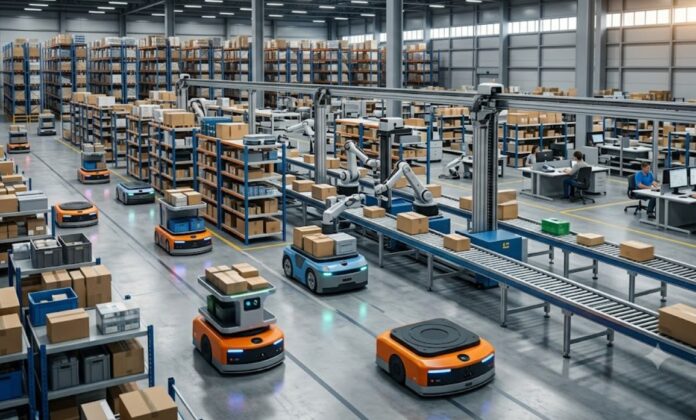
Two companies — Mytra and Sereact — accounted for roughly 69% of all disclosed warehouse robotics funding in early 2026. That’s not a sign of a booming category. It’s a sign of a maturing one, where investors have stopped spreading small bets and started writing much larger checks to fewer, more proven teams.
Warehouse robotics startups raised roughly $336 million across 8 disclosed deals in early 2026, up from about $92 million across 7 deals over the same period in 2025 — capital up 3.7x on barely more deals. The average round size nearly tripled, from about $13 million to $42 million, and Series B and C rounds captured roughly 95% of that capital. Notably, none of the qualifying rounds were first-time financings; every dollar went to a company that had already raised before. New-startup formation, at least the kind that shows up in disclosed funding data, has gone quiet.
That pattern holds across the ten rounds below, which range from a $120 million Series C to a $5 million top-up on a company that’s raised nearly $300 million total. Read together, they show where investors currently believe warehouse automation actually pays off: pallet-scale robotics, AI software that makes existing robot arms smarter, and narrow, well-defined tasks like sortation, inventory scanning, and truck unloading — not new general-purpose platforms.
The Megarounds: Two Companies, $230 Million, One Story About Scale
1. Mytra — $120M Series C (January 2026)
Mytra’s 3D pallet-moving robotics platform pulled in the largest single round of the period, backed by Avenir Growth, Kivu Ventures, and D. E. Shaw, with a team drawing more than 50 people from Tesla, Rivian, and Google. The pitch is squarely about labor: the U.S. warehouse sector faces roughly 2 million unfilled positions, and Mytra’s system is designed to move pallets through a 3D grid without the fixed conveyor infrastructure that makes traditional automated storage systems expensive to reconfigure.
2. Sereact — $110M Series B (April 2026)
Sereact doesn’t build robot hardware — it sells the AI layer that makes existing robot arms handle tasks they weren’t explicitly programmed for. The Stuttgart-based company’s Series B, led by Headline with Bullhound Capital, Daphni, and Felix Capital participating, funds a U.S. expansion and its new first Boston office, alongside development of Cortex 2.0, a system that lets a robot simulate several possible actions before committing to one. The company says it has more than 200 systems live across Europe, with over a billion production picks completed and roughly one human intervention needed per 53,000 picks. Zalando joined as a strategic investor in a follow-on close in July, alongside existing customers BMW and PepsiCo.
The Mid-Size Rounds: Betting on Specific, Narrow Jobs
3. SEER Robotics — $59M IPO (June 2026)
SEER took the public-market route rather than another private round, backed historically by Hillhouse Capital, IDG Capital, and SAIF Partners. The company builds AMR controllers and mobile robot platforms rather than a single branded robot — infrastructure other warehouse operators build on top of, which is a different bet than the application-specific startups on this list.
4. Gather AI — $40M Series B (February 2026)
Gather AI’s autonomous drones fly warehouse aisles to scan inventory and pallet placement without a human walking the racks with a scanner gun. The round, backed by Smith Point Capital Management, Bain Capital Ventures, and Tribeca Venture Partners, pushes the company’s total raised to roughly $74 million — inventory visibility has become one of the more consistently funded narrow use cases in the category, since the ROI case (fewer stockouts, faster cycle counts) is easy for a warehouse operator to model.
5. Unbox Robotics — $28M Series B (January 2026)
Unbox’s sortation robots target a specific bottleneck: parcel and case sorting in mid-sized fulfillment operations that can’t justify a full Symbotic- or AutoStore-scale installation. Backed by ICICI Venture, Redstart Labs, and F-Prime, the round reflects continued investor interest in sortation as a category distinct from general goods-to-person automation.
The Early-Stage Layer: Smaller Checks, Still Moving
6. Smart Robotics — $11M Series A (April 2026)
The Rotterdam-based robotic picking company raised from Rotterdamse Havendraken, Innovation Industries, and Ernij Next — investors with a clear port-and-logistics-corridor focus, suggesting a deployment strategy built around European transshipment hubs rather than a broad horizontal sales push.
7. Nomagic — $10M Series B Extension (February 2026)
Nomagic’s warehouse picking arms picked up a Series B extension from Cogito Capital, the EBRD, and Khosla Ventures — a top-up rather than a new priced round, which typically signals a company extending runway on existing momentum rather than raising against a new valuation milestone.
8. Anyware Robotics — Seed Round, Undisclosed (March 2026)
Anyware’s Pixmo robot unloads shipping containers and trucks — a job the company says cuts receiving labor costs by up to 60% for customers like Western Post, which runs Pixmo against more than 45,000 containers a year. This March 2026 round follows a $12 million seed in 2025 and brings the company’s total raised to roughly $17.7 million — a modest but real signal that investors are still funding narrowly-scoped, single-task robots, just in smaller amounts than the pallet- and AI-platform plays above.
9. ANSCER Robotics — $5M Series A (May 2026)
ANSCER’s AMR line picked up a Series A from IAN Alpha Fund, Info Edge, and angel investors — a comparatively small round that puts it firmly in the early-commercialization tier rather than the scale-up tier occupied by the rest of this list.
The Cautionary Tale: When a $296M Company Raises $5M
10. Dexterity — $5M Series C-II (June 2026)
Dexterity has raised more total capital than any other company on this list except Mytra and Sereact — roughly $296 million across eight rounds, backed over time by Lightspeed Venture Partners, Kleiner Perkins, and Sumitomo. Its June 2026 round was a $5 million top-up, not a new flagship raise. Read next to Mytra’s $120 million and Sereact’s $110 million, that gap is the clearest single data point on this list about where investor conviction currently sits: not with the companies that have raised the most historically, but with the ones showing the sharpest recent momentum.
Bottom Line
The headline number — capital up 3.7x — makes 2026 look like a boom year for warehouse robotics. The deal-level detail tells a narrower story: two companies captured most of the money, every disclosed round went to a company that had already proven itself with an earlier raise, and the size of a company’s total historical fundraising says surprisingly little about whether its most recent round was a vote of confidence or a bridge to the next one. For an operator evaluating vendors in this category, the funding data is a genuinely useful signal — but only if you’re reading round size and round type together, not total capital raised alone.