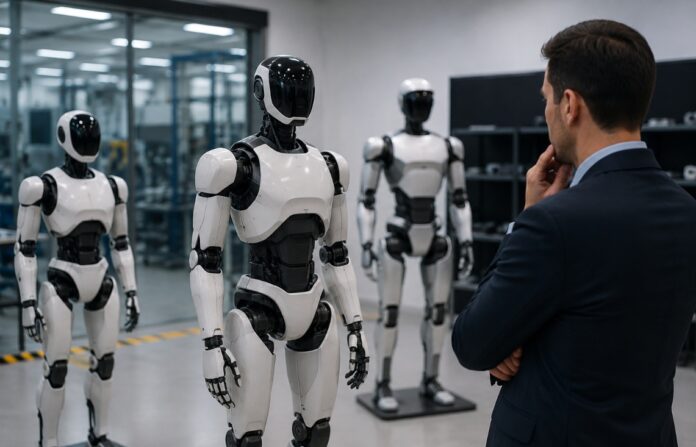
Humanoid robotics has entered a more demanding phase. For years, the industry was judged largely by demonstrations: walking across uneven terrain, lifting boxes, manipulating tools or performing carefully staged tasks. In 2026, those demonstrations still matter, but buyers increasingly want a different set of answers. Can the robot be acquired? What work can it perform repeatedly? How much integration is required? What does it cost to operate? Who supports it after deployment?
That shift from technical spectacle to commercial scrutiny is healthy. A humanoid robot can be mechanically impressive and still be a poor investment for a factory, warehouse, research laboratory or service business. The strongest purchasing decisions begin by separating capability from availability and availability from economic value.
The market is no longer one category
The term “humanoid robot” now covers machines with very different purposes. Some platforms are designed primarily for research and development. Others are being tested for logistics, manufacturing and material-handling work. A smaller group is moving toward home or light-commercial use. Comparing them only by height, walking speed or number of joints can therefore be misleading.
For prospective buyers, one of the most useful first steps is identifying which humanoid robots for sale are genuinely obtainable and which remain limited to enterprise pilots, leasing arrangements, research programs or manufacturer-controlled deployments. A robot that appears in a polished demonstration video is not necessarily a product that an ordinary business can order.
Availability matters as much as capability
Commercial availability is more complicated in humanoid robotics than in mature equipment markets. A manufacturer may announce a target price without accepting open orders. Another may offer hardware only to selected enterprise partners. Some platforms are sold to developers but require significant software work before they can perform useful tasks. Others are offered through robotics-as-a-service or pilot contracts rather than conventional equipment purchases.
This is why buyers should ask for a precise acquisition path. Is the quoted figure a purchase price, estimated future price, lease, subscription or pilot fee? Is the hardware shipping now? Is there a waiting list? Are software licenses, maintenance, training, spare parts and integration included? The answers can change the economics dramatically.
The real comparison is task performance
Humanoid form factors are attractive because many workplaces were built around the human body. Doors, stairs, shelves, carts, tools and workstations already assume human reach and mobility. In theory, a sufficiently capable humanoid can enter those environments without requiring the facility to be rebuilt around the machine.
In practice, buyers should evaluate the specific task rather than the general promise of human-like versatility. A robot that can lift a useful payload may still be too slow for a production cycle. A machine with advanced hands may require frequent intervention. A platform that walks well may not yet have the perception, dexterity or reliability required for a particular workflow.
The right benchmark is therefore not whether a humanoid can perform a task once. It is whether it can perform that task repeatedly, safely and economically across a real operating shift.
Understanding the technology without getting lost in jargon
For non-specialist buyers asking what is a humanoid robot, the simplest useful definition is a mobile robotic system designed around a human-like body plan so it can operate in spaces and workflows originally designed for people. The important engineering layers include locomotion, perception, manipulation, computing, power, safety systems and software that converts goals into physical actions.
Those layers are tightly connected. Better artificial intelligence does not eliminate the need for reliable actuators, sensors, batteries and low-latency control. Likewise, excellent hardware has limited value if the robot cannot understand its environment or recover from unexpected conditions. Commercial success depends on the entire system working together.
Price is only the beginning of the cost equation
Humanoid pricing attracts attention because manufacturers and analysts often discuss the possibility of costs falling as production scales. But acquisition price is only one part of the investment. Businesses should model integration, software, maintenance, charging infrastructure, training, supervision, downtime and the internal labor required to manage the deployment.
A lower-priced robot that requires constant engineering support may cost more to operate than a more expensive platform with mature fleet management and dependable service. Conversely, a highly capable premium robot may be unnecessary when a specialized mobile robot, cobot or fixed automation system can complete the same job more simply.
Humanoids versus specialized robots
This may be the most important strategic question in the buying process. Humanoid robots offer the possibility of flexibility across multiple human-designed tasks. Specialized robots are usually optimized for narrower jobs and can be faster, simpler and easier to justify economically.
A warehouse that needs predictable tote movement may be better served today by proven autonomous mobile robots and conveyors. A manufacturer with a repetitive workstation may prefer a conventional industrial robot or collaborative arm. Humanoids become especially interesting where the environment changes, multiple tasks must be handled, or redesigning the workplace around fixed automation would be expensive.
Deployment evidence should outrank demonstrations
Buyers should distinguish between a prototype demonstration, a controlled pilot and a sustained commercial deployment. The distinction matters because each stage reveals different risks. A demonstration proves that a task is technically possible. A pilot begins to test integration and reliability. A sustained deployment begins to reveal whether the economics and operational support actually work.
Useful diligence includes asking how many units are operating outside the manufacturer’s own facilities, what tasks they perform, how many hours they run, how often humans intervene and what happens when a unit fails. Buyers should also ask whether published performance figures came from production environments or controlled tests.
Safety and integration will determine adoption speed
Humanoids are designed to work in environments occupied by people, which makes safety and systems integration central purchasing issues rather than afterthoughts. Facilities need clear procedures for emergency stops, restricted areas, charging, cybersecurity, software updates and human interaction. The organization also needs to determine who owns the deployment internally: operations, engineering, IT, safety or a cross-functional team.
Integration with warehouse-management, manufacturing-execution or enterprise systems can be just as important as the robot’s physical capabilities. A machine that moves an object but cannot reliably communicate task completion, exceptions or inventory status may create more operational complexity than it removes.
A practical buyer checklist for 2026
Before signing a purchase, lease or pilot agreement, buyers should be able to answer a small set of practical questions: What exact task will the robot perform? What measurable result defines success? Is the robot commercially obtainable now? What is included in the quoted price? What human supervision is required? How is service handled? What happens during downtime? Can the platform integrate with existing systems? And what alternative specialized automation could accomplish the same objective?
These questions are less exciting than watching a robot walk, but they are far more important to determining return on investment.
The next stage of humanoid robotics will be measured in outcomes
The humanoid market is moving quickly, and the range of available machines, deployment models and use cases will continue to change. The winners will not necessarily be the robots with the most dramatic demonstrations. They will be the platforms that can move from demonstration to dependable work while reducing the friction of deployment.
For buyers, that means treating humanoid robots the way they would treat any other major piece of operational technology: define the job, verify the evidence, understand the full cost, test the integration and measure the outcome. The technology is becoming more capable. The purchasing process now needs to become equally disciplined.
About the author
Randy Levine is the founder of Whichbot.net, an independent robotics research and comparison platform tracking humanoid, home, construction and commercial robots, including specifications, pricing, availability and real-world deployment evidence.