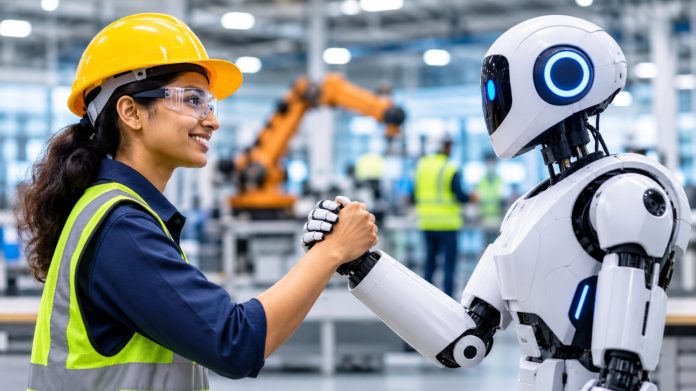
SUMMARY: Robotics deployments stall for several reasons, and hardware reliability and technical integration are among them. A pattern that is easy to overlook, though, is that many deployments also stall at the points where work passes between people and machines and nobody has designed that handoff, which is why the organizations that benefit most from automation tend to be the ones that redefine the job around what the machines make possible and give the people closest to the work a way to stop a process when something goes wrong.
A factory floor in 1979
On 1 February 1979, Deng Xiaoping, then China’s vice premier, toured Ford’s Atlanta Assembly Plant in Hapeville, Georgia, during the first official visit by a Chinese leader to the United States. Ford’s own account of the visit notes that the plant’s monthly output exceeded China’s total annual automobile production at the time.
What a visitor notices first on a floor like that is the machinery, which is also where most deployment plans put their attention. What the visit could not show was the arrangement of people and machines around each other, and that arrangement turns out to decide whether the same equipment produces good results in one plant and poor results in another.
What happened to the ice harvesters
The natural ice trade offers a useful long view of how automation waves treat the people inside them. Beginning around 1850, demand for ice supported a large harvesting industry along rivers such as the Hudson, and after World War I mechanical refrigeration ended it, leaving the industry largely finished by the early 1920s, and mechanical refrigeration kept replacing what remained of natural ice through the 1920s and 1930s. Historians of the trade, including Gavin Weightman in The Frozen Water Trade (2003), trace how natural ice gave way to ice plants and then to the home refrigerator, and by and large the companies that led one stage were not the ones that led the next.
The pattern behind that story matters more than the details. Companies that defined themselves by a task, such as cutting and hauling ice, were replaced by companies that defined themselves by the purpose the task served, which was keeping things cold. Every automation wave seems to reward the people who redefine the job around its purpose, and it tends to punish the ones who defend the task as it used to be done.
What the andon cord changed at NUMMI
At General Motors’ Fremont plant in the 1970s, workers recall that stopping the line to fix a problem could get them fired, and the plant had some of the worst quality in the company. When Toyota and GM reopened it as NUMMI, Toyota introduced the andon cord, a rope along the assembly line that any worker could pull to summon a team leader and, if the problem could not be fixed in time, stop the line, as NPR described in its 2010 report on the plant’s closing.
The results were large, since according to former Toyota manager John Shook, quality at the plant went from GM’s worst to GM’s best in a single year with the same workers, and IndustryWeek reported that absenteeism fell from 20% to 2%. Rick Madrid, a longtime GM worker who trained in Japan and saw workers stop the line to fix a bolt, told NPR that “one bolt changed my attitude.”
The workers were the same before and after, and what changed was that the people closest to the work were given a legitimate way to stop it. That is the kind of design decision that automation projects tend to skip, because it concerns authority and trust more than equipment.
To me, NUMMI was not a technology story but a trust story, because management did not simply hang a rope along the line but handed workers the authority to pull it and then meant it, and the trust ran in both directions, since workers trusted the system once the system trusted them. When the new coworker is a machine the rule does not change, because people trust a machine that they are allowed to stop.
Where robot deployments stall
Hardware reliability and technical integration are real challenges in any robotics deployment, and they are rightly the first things most plans address, so the question here is what tends to go wrong in addition to them. The evidence points to the places where people and machines meet, which are easy to overlook because they rarely belong to anyone’s budget line.
Harvard Business Review interviewed 34 warehouse workers and 33 front-line supervisors in the United States, United Kingdom, Spain, France and China, and FreightWaves reported that four in ten employees had negative feelings toward warehouse automation, with inadequate training among the fears raised most often. A SupplyChainBrain summary of an industry survey lists training and change management, along with fear and uncertainty, among the barriers to adoption.
A modern example: exceptions in warehouse picking. Modern warehouse robotics shows a technical version of the same pattern. Erik Nieves, CEO of Plus One Robotics, told Supply Chain Management Review that variability is the rule in real supply chains, so robots that pick, sort and unload regularly meet scenes they cannot interpret, such as a conveyor carrying several product types where one item is inside an envelope. His company’s approach is for the robot to proceed on its own when its confidence is high and to call a human operator when confidence falls below a threshold, and he notes that exceptions never reach zero because new products and packaging keep arriving. Plus One Robotics’ own case study of a deployed pick-and-place system found that a vision model’s average precision fell from 0.95 on its original test set to 0.58 on new post-deployment data and recovered after the model was updated with data collected from human supervisors. That is a genuine technical limit and not a failure of people, which is exactly why the handoff to a human has to be designed for it. Both sources come from the vendor side, so they are best read as a practitioner’s view and not as independent research.
Scenario 1: workers who were never told what changes for them. A deployment that arrives without a clear account of what each role will do afterwards invites the fears that the Harvard Business Review interviews found, and the people who are worried are the same people who will be expected to handle the exceptions.
Scenario 2: an exception with no owner. Consider what happens when a robot reaches the limit of what it can do. Someone has to see the exception, understand it and resolve it, and the system has to learn from the result, but if the alert goes to a queue that nobody owns, or to a person with no authority to stop the line, the robot waits while the rest of the process backs up, and the exception looks like a hardware fault even though the design gap is in the handoff.
Scenario 3: robots and people working in separate silos. An article in Supply & Demand Chain Executive, written from the viewpoint of a software vendor, argues that automated equipment often disappoints because robots and human workers operate in disconnected silos, and gives the example of robots left idle because workers did not decant inbound inventory fast enough. Whether or not that vendor’s solution is the right one, the example shows how a delay in a human step can look like a robot problem.
These findings point to the same place from different directions: the equipment is often capable, and the difficulty lies in what people are asked to do around it. My view is that hardware and integration problems are real but are only part of the story, because many deployments also stall where the human handoff was never designed, meaning the moments when a robot’s work becomes a person’s work, when a robot cannot complete a task and a person has to step in and when someone needs to stop the process and has no clear authority to do so.
As an anthropologist, I would say that trust has always been local. For most of human history we lived in small groups and trusted the people we had watched work, because we built things alongside them, and people come to trust a machine in the same way, through small, repeated and visible moments in which it does what they expect. Trust breaks in the same way, when the machine does something that nobody can explain and nobody can stop, and one unexplained failure can cost more trust than a hundred quiet successes earn, which is why the exception with no owner in the second scenario does so much damage.
A handoff checklist for operations leaders
Before a deployment moves beyond the pilot, these questions can be asked of each point where people and machines meet:
- Who owns the point where the robot’s output becomes a person’s input and what happens when the robot cannot finish a task?
- Who is allowed to stop the process and what happens to the person who does?
- What will people do once the routine task is automated and who decided that?
- How are exceptions handled, who sees them and how quickly does the system learn from them?
- When does training happen relative to deployment and does it include the people who will cover when the system fails?
Each question can be paired with a number that a team can track from the first week of deployment, and the trend in these numbers will show whether the handoff is working long before an annual review would.
| Handoff question | What to measure |
| Who owns the point where the robot’s output becomes a person’s input? | Handoff wait time, meaning how long the robot or the person waits for the other side. |
| Who is allowed to stop the process? | The number of stop events and the time from a stop to a restart. |
| What will people do once the routine task is automated? | The share of affected employees who have completed training before go-live. |
| How are exceptions handled? | Exception resolution time, meaning the median time from a flagged exception to a person resolving it, and human intervention frequency, such as interventions per 1,000 tasks. |
| When does training happen? | Robot-related downtime per shift, split by cause: hardware, software and waiting for a human step. |
A deployment that can answer these questions in writing has designed its handoffs, whereas one that cannot is relying on the people involved to improvise, which they will do, though not always in the direction the project intended.
What the pattern suggests
The three scenes in this article point to the same conclusion from different centuries and industries. In the Atlanta plant, the machinery was the visible part and the arrangement around it was not. In the ice trade, the organizations that adapted were the ones that changed what they thought their job was. At NUMMI, results changed when the people nearest the work gained the authority to stop it.
I learned this early, in the first company I founded. We had built a shopping assistant on Microsoft’s Kinect camera, and during our experiments we found that the machine vision could tell whether a shopper liked a product from their body language and from how long they held it, often more reliably than the shopper could tell us. People’s bodies were telling the truth that their words were not, and a leader rolling out automation should watch in the same way, because surveys and town halls tell you what people say whereas the floor tells you what they do, so the question to ask is where people are quietly routing around the system, since the workaround is often the most honest feedback that a deployment will give you.
For leaders planning the next robotics deployment, the practical step is to treat the handoff between people and machines as a design problem with an owner and a deadline, in the same way that the hardware is, because hardware alone is rarely the whole story.
Sources
- Digital Library of Georgia, Deng Xiaoping touring the Ford Assembly Plant, Hapeville, 1 February 1979
- Ford Motor Company, account of the 1979 visit
- Farm Collector, Ice harvesting in the 19th century
- Recollection Wisconsin, Ice harvesting
- Gavin Weightman, The Frozen Water Trade (2003)
- NPR, The End of the Line for GM-Toyota Joint Venture and its transcript
- Lean Enterprise Institute, John Shook on NUMMI
- IndustryWeek, The Art of Change
- FreightWaves, Warehouse workers weigh in on automation in the workplace, reporting on Harvard Business Review research
- SupplyChainBrain, Warehouse automation: the drivers, the barriers and the trends
- Supply Chain Management Review, Why fully autonomous warehouses are still out of reach for most
- Plus One Robotics, Robots Work, People Rule: Human-Centered Pick-And-Place Automation
- Supply & Demand Chain Executive, Overcoming the Automation ROI Crisis: Why “Islands of Automation” Fail
About the author: Sam Rad is an anthropologist, futurist, four-time tech founder and #1 bestselling author of Radical Next: Reclaiming Your Humanity in a Post-Human World. She speaks to leaders about how to navigate technological change, and her keynote, Change Has a Pattern, helps them understand why new technology often takes time to pay off and how to turn the corner.