Manufacturing automation has become the cornerstone of competitive advantage in today’s industrial landscape. According to recent Deloitte research, companies that successfully implement CAD/CAM systems reduce product development time by 25-40% and achieve manufacturing accuracy rates of up to 99.8%.
However, selecting the right solution remains a complex challenge. A poor choice can result in millions of euros in losses and months of production downtime.
Evaluating CAD/CAM Solutions for Manufacturing
The first rule of successful selection — start with your production requirements, not software capabilities.
Key questions to address:
- Part complexity: Simple prismatic components require basic functionality, while complex aerospace parts demand advanced 5-axis strategies
- Production volumes: Job shops prioritize flexibility, while high-volume manufacturers need programming speed
- Workforce skills: Some systems require weeks of training, others enable productivity within days
Practical tip: Create a matrix of 10-15 typical parts from your production and measure current programming times. This establishes your baseline for comparison.
Compatibility Analysis with Existing Equipment
Compatibility extends far beyond post-processors.
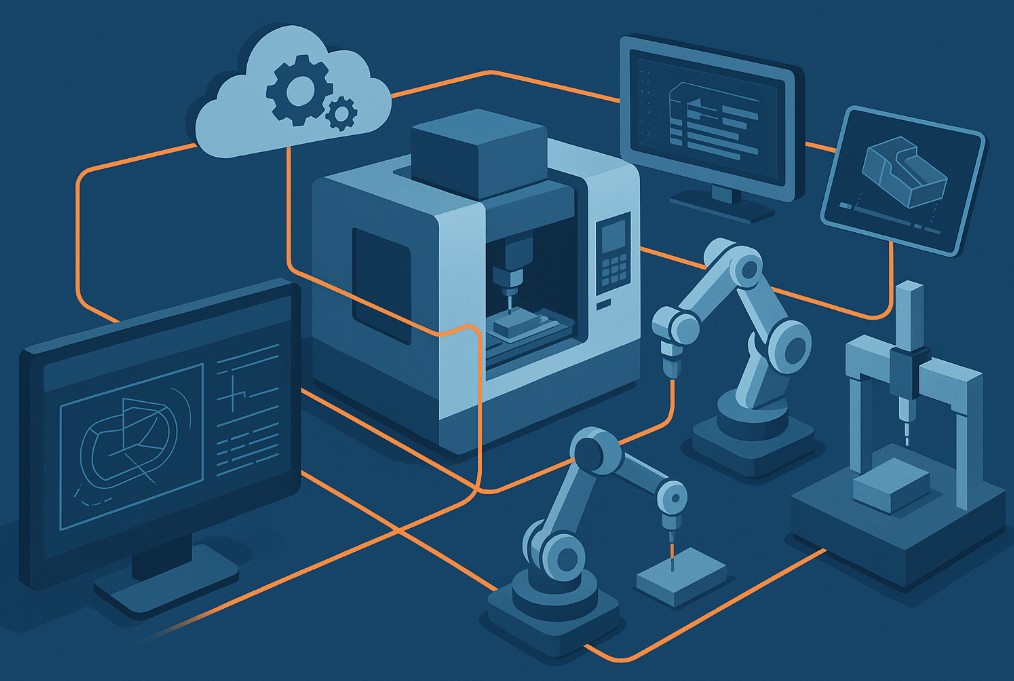
Modern manufacturing environments include:
- CNC machines from multiple vendors
- Industrial robots
- Coordinate measuring machines (CMMs)
- Manufacturing execution systems (MES/ERP)
Critical consideration: The system must integrate seamlessly with your digital manufacturing ecosystem, not just generate G-code.
Real-world example: A precision engineering company in Bavaria spent 10 months configuring integration between their CAD/CAM system and robotic cell simply because they overlooked data communication protocols during selection.
Functionality Assessment: From 3D Modeling to Post-Processing
Essential vs Advanced Capabilities
Must-have features:
- Import of standard CAD formats (STEP, IGES, Parasolid)
- 5D and 3D machining strategies
- Collision detection and material removal simulation
- NC code generation for your machine tools
Advanced capabilities:
- Adaptive machining strategies
- Automatic feature recognition
- Machine-specific trajectory optimization
- Cloud collaboration for distributed teams
Modern solutions like CAD/CAM software from ENCY demonstrate a new integration approach — a unified ecosystem combining design, CNC programming, robotics, and digital manufacturing in a cloud environment.
Specialized Modules
Each manufacturing type has specific requirements:
Turning operations: Swiss-type support, Y-axis capabilities, sub-spindle programming Milling applications: 5-axis strategies, high-speed machining, thin-wall optimization Robotics integration: Offline programming, trajectory optimization, singularity avoidance
ROI Calculation for New CAD/CAM Implementation
Direct Costs and Savings
Investment components:
- Software licenses: €10,000 – €150,000 per seat
- Staff training: €3,000 – €8,000 per engineer
- Implementation consulting: €20,000 – €60,000
- Production downtime during migration
Savings sources:
- Programming time reduction (typically 30-50%)
- Scrap reduction through accurate simulation
- Increased machine utilization
- Optimized tool consumption
Case study: An automotive supplier in Stuttgart achieved ROI within 16 months by reducing complex part programming time from 8 to 3 hours.
Hidden Benefits
Often undervalued factors:
- Scalability: Easy integration of new equipment
- Standardization: Unified approaches reduce dependency on specific personnel
- Digitalization: Manufacturing data for analytics and planning
Migration Stages and Personnel Training
Phased Migration — Key to Success
Phase 1: Pilot Project (1-2 months)
- Select 2-3 representative parts
- Train core specialists
- Configure basic post-processors
Phase 2: Expansion (3-6 months)
- Connect additional equipment
- Train remaining staff
- Optimize workflows
Phase 3: Full Implementation (6-12 months)
- ERP/MES system integration
- Deploy advanced features
- Analyze and optimize results
Training Criticality
Statistics are clear: 70% of failed implementations stem from inadequate staff preparation, not technical issues.
Effective approaches:
- Blended learning: Online courses + hands-on workshops
- Mentoring: Experienced users guide newcomers through initial months
- Progressive complexity: From simple to complex parts
Current Trends: Cloud Solutions and AI in CAD/CAM
Cloud Technology Transforms the Landscape
Cloud CAD/CAM advantages:
- Access to powerful computing without expensive workstations
- Automatic updates and backup
- Collaboration across geographically distributed teams
- Flexible licensing models
Particularly relevant for companies with multiple facilities or remote engineers.
Artificial Intelligence in Manufacturing
Practical AI applications:
- Automatic feature recognition on 3D models reduces preparation time by 40%
- Trajectory optimization considering specific machine and tool characteristics
- Predictive analytics for tool breakage prevention
Key insight: AI doesn’t replace engineers but amplifies their capabilities by automating routine operations.
Selecting a CAD/CAM system represents an investment in your manufacturing future. The right choice will not only pay for itself within 1-2 years but also provide the foundation for continued growth and digitalization.
Primary recommendation: Don’t chase maximum functionality. Choose a system that addresses your current challenges while offering growth potential alongside your business evolution.
The European manufacturing sector’s emphasis on precision, efficiency, and sustainability makes thoughtful CAD/CAM selection more critical than ever. Invest time in the selection process — your future competitiveness depends on it.