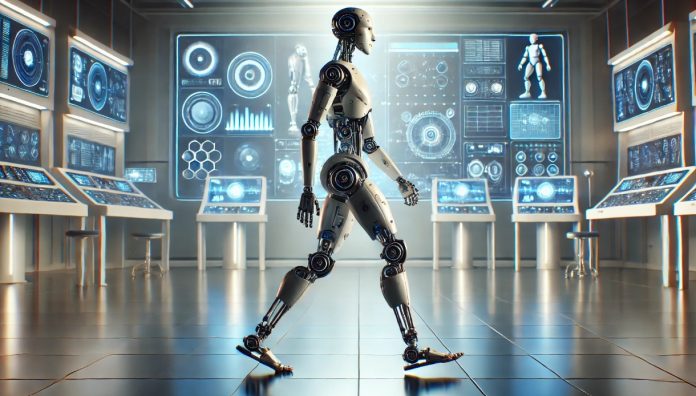
For decades, roboticists have dreamed of creating machines that can walk, run, and move just like humans. While flying robots and wheeled systems have made remarkable progress, the challenge of humanoid walking remains one of the most complex problems in robotics. From the way we shift our weight while walking to the micro-adjustments our bodies make to maintain balance, bipedal locomotion involves an intricate blend of biomechanics, neural control, and adaptive sensing.
Humanoid walking is not just about mimicking human movement—it’s a bold endeavor to engineer mobility that can function in real-world human environments. As robotics moves out of the lab and into homes, hospitals, and disaster zones, the ability to walk like a human becomes a game-changing feature.
This article explores the core concepts, challenges, and evolving strategies behind humanoid walking. Drawing from insights shared by experts in the field, it dives into how researchers deconstruct human locomotion, how they translate it into robotic motion, and what the future holds for walking machines.
Why Walking Matters in Robotics
Most environments built by and for humans—stairs, uneven terrain, tight spaces—are not ideal for wheels. Bipedal walking, while less stable than wheeled motion, offers unmatched adaptability in such settings. A robot that walks like a human can go where wheels can’t: up stairs, over rubble, or across crowded rooms.
But the task is far from trivial. Even for humans, walking is a complex interplay of body mechanics and neural control. Replicating it in robots requires understanding and programming balance, coordination, joint actuation, and feedback control—every fraction of a second.
Walking Isn’t Just Repetition—It’s Controlled Falling
At first glance, walking might seem like a repetitive, straightforward activity. But a closer look reveals a surprisingly dynamic process. In essence, walking is a form of controlled falling. Humans continuously fall forward and use one foot after another to catch themselves. The center of mass (COM) moves ahead, and the legs swing and land in a way that prevents us from toppling over.
Replicating this in robots means engineers must coordinate multiple factors: where to place the foot, how fast to swing the leg, how to shift the center of mass, and how to handle external disturbances. These adjustments happen so smoothly in humans that we rarely think about them—but they’re exceptionally difficult to program.
The Complexity of Human Gait
Human walking is a marvel of evolution. The average person takes over 10,000 steps a day, yet rarely trips or falls. This stability comes from a finely tuned coordination of:
- Muscle actuation: Different muscles engage at specific moments.
- Sensory feedback: Visual, vestibular, and proprioceptive inputs help adjust movement.
- Center of mass control: The body instinctively shifts weight to maintain balance.
- Energy efficiency: Tendons and muscles store and release energy to reduce effort.
In robots, replicating even one of these aspects is complex. Getting all of them to work in harmony—especially across varied terrains—is one of the biggest challenges in humanoid robotics.
From Rigid Kinematics to Dynamic Models
Early roboticists treated humanoid walking like an engineering control problem. They used rigid-body kinematics and predefined trajectories to move legs. While this worked on flat, predictable surfaces, it failed on dynamic terrains. Robots stumbled, fell, or froze in uncertainty.
Modern approaches lean more toward dynamic models—treating the robot not just as a rigid machine but as a dynamically balanced system. One breakthrough is the inverted pendulum model. This model considers the human body as a mass atop a pendulum (the leg), swinging forward while keeping the body upright. It simplifies complex motion into a manageable dynamic system, enabling more natural and adaptive walking patterns.
Key Approaches to Humanoid Walking
Humanoid walking research has evolved to include several distinct approaches. Each balances trade-offs between stability, adaptability, and computational demand.
1. Zero Moment Point (ZMP) Control
ZMP-based walking involves ensuring that the net moment (torque) around the contact point of the foot is zero. If the robot’s motion keeps the ZMP inside the support area of the foot, it remains balanced.
Pros:
- Highly stable on flat ground.
- Suitable for slow, deliberate walking.
Cons:
- Computationally expensive.
- Lacks agility and doesn’t work well on uneven surfaces.
ZMP walkers like Honda’s ASIMO are known for precise movements but tend to have an awkward, slow gait that lacks the natural flow of human walking.
2. Passive Dynamic Walking
This approach builds on the idea that walking can be achieved with minimal actuation. By designing robots with carefully tuned physical structures—correct leg length, mass distribution, and joint damping—robots can walk down a slope using gravity alone.
Pros:
- Energy-efficient and elegant.
- Mimics natural human motion.
Cons:
- Limited to specific conditions (e.g., a gentle slope).
- Hard to control or steer.
Passive dynamic walkers demonstrate that form and physics alone can produce realistic walking behavior. However, they’re not versatile enough for real-world application.
3. Hybrid and Learning-Based Models
The cutting edge in humanoid walking uses reinforcement learning and model predictive control (MPC). Instead of hard-coding every motion, robots learn optimal behaviors by trial and error. Combined with sensors and high-speed processors, they can adapt in real time to obstacles, terrain, or changes in load.
Companies like Boston Dynamics and research institutions like MIT’s CSAIL are leading this charge. Their robots walk dynamically, recover from pushes, and learn to navigate complex paths.
The Challenge of Balance and Disturbances
Walking robots need to maintain balance under constant disturbances—bumps, slips, uneven surfaces, or sudden loads. Human beings rely on our vestibular system and fast muscle responses to adjust posture. In robots, these adjustments must be computed and executed in milliseconds.
Researchers use gyroscopes, accelerometers, and force sensors to mimic this process. They also implement feedback control loops, allowing the robot to detect imbalance and correct it before falling. But latency, actuator limitations, and environmental unpredictability still pose serious challenges.
Energy Efficiency and Power Constraints
Human walking is incredibly efficient—we use tendon elasticity and muscle memory to conserve energy. In contrast, robots consume far more power, especially when trying to stabilize themselves dynamically.
Designing energy-efficient actuators and control algorithms is an ongoing area of research. Some promising ideas include:
- Series elastic actuators: Mimic human tendon-like elasticity.
- Optimal control algorithms: Minimize unnecessary joint torque.
- Energy recycling: Store and reuse motion energy.
Improving power efficiency is critical for deploying humanoid robots in real-world applications, where battery life and heat dissipation are real bottlenecks.
Real-World Applications and Constraints
Why invest so much into walking robots when wheels are simpler? The answer lies in versatility.
- Disaster response: Robots that can walk over rubble can reach victims in collapsed buildings.
- Assisted living: Humanoid robots could help the elderly or disabled navigate daily life.
- Space exploration: Uneven extraterrestrial terrain may require walking, not rolling.
Yet for these applications to work, walking robots must be robust, adaptable, and energy-efficient—not just technically capable but practically useful.
Toward Human-Like Agility and Adaptability
The holy grail of humanoid robotics is not just to walk—but to walk like us. That means:
- Adapting to uneven ground
- Climbing stairs or crouching
- Reacting to unexpected events
- Walking with rhythm and intention
Humans can dance, sprint, tiptoe, or hop on one foot. Each of these actions involves real-time adjustments in balance, motion planning, and force distribution. While we’re still far from achieving this level of fluidity in robots, the gap is slowly narrowing.
Advancements in machine learning, tactile sensing, and biomechanics-inspired design are making robots more capable of matching human agility. Future humanoids may not just walk—they may move among us, intuitively and seamlessly.
Conclusion
Humanoid walking remains one of the most challenging frontiers in robotics, demanding an intersection of mechanical engineering, computer science, neuroscience, and physics. From zero moment point control to passive dynamics and reinforcement learning, the field is evolving rapidly—but many hurdles remain.
As robots become increasingly part of our homes, workplaces, and public spaces, their ability to walk like us will determine how naturally and safely they can integrate into our lives. Walking is more than locomotion—it’s a statement of human-level interaction. And every step forward in this field brings us closer to a future where robots walk among us—not just in factories, but in everyday life.