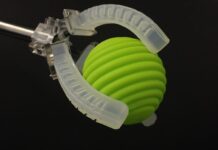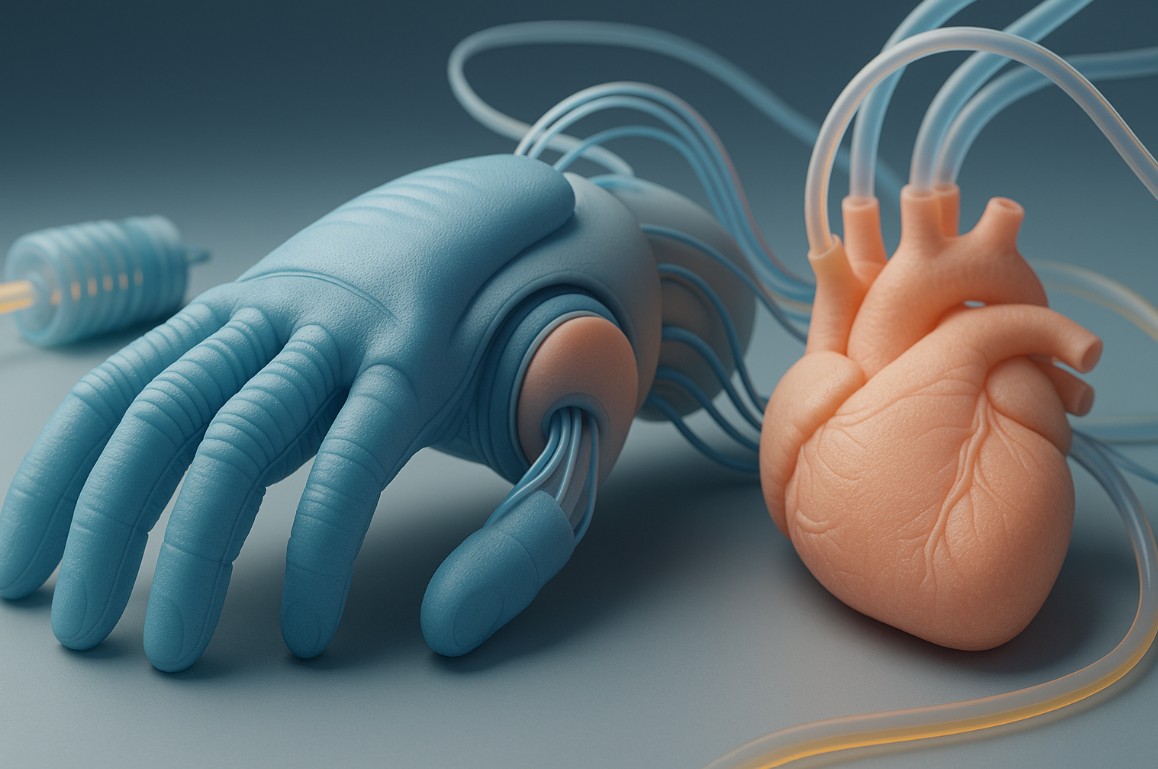
Imagine a robot that’s not built with metal joints or rigid plastic, but with soft, pliable materials that mimic muscles and skin. A robot that can gently grasp a strawberry without bruising it, or wrap around a human heart to support its beating. This is not science fiction—it’s the rapidly emerging field of soft robotics, a discipline that merges biology, engineering, materials science, and electronics.
In contrast to the traditional image of robotics—rigid, metallic, and mechanical—soft robots are flexible, adaptive, and biomimetic, making them ideal for applications in medicine, manufacturing, space, and even virtual reality. This article explores the principles, innovations, applications, and challenges of soft robotics, as described through a firsthand research experience and backed by cutting-edge developments from leading labs around the world.
Why Softness Matters in Robotics
When we imagine robots, we often picture humanoid figures or industrial arms—machines built for strength, speed, and precision. But this traditional approach may be fundamentally flawed if we’re aiming to create machines that truly resemble or interact seamlessly with humans.
The human body itself offers a powerful clue: it’s predominantly soft. In fact, about 80% of the human body is composed of soft tissues, including muscles, organs, and fluids, while only about 10 kilograms in an average adult male account for the hard skeleton. This soft structure allows us to move gracefully, heal naturally, and adapt to our environments. If roboticists want to replicate human-like performance, softness isn’t a limitation—it’s a requirement.
What Is Soft Robotics?
Soft robotics refers to a class of robotic systems made entirely or predominantly from soft, flexible materials, such as silicone, elastomers, and smart polymers. Unlike rigid robots, these systems can bend, twist, stretch, and conform to their environment, mimicking biological movement and interaction.
Soft robotics incorporates:
- Soft actuators for movement
- Soft sensors for feedback
- Soft power systems for autonomy
- Control electronics for coordination
A complete soft robot might not even look like a robot in the traditional sense—but rather a wearable sleeve, an inflatable gripper, or a shape-shifting lens.
Real-World Applications
Despite being in early stages, soft robotics is already demonstrating revolutionary potential across multiple sectors:
-
Medical Devices and Biohybrid Systems
One of the most promising applications of soft robotics is in medicine. Take, for example, a soft robotic sleeve that wraps around a failing human heart, augmenting its pumping action. This type of biohybrid actuator can extend life and improve patient outcomes by offering a gentler, more integrated solution than mechanical pumps.
In another breakthrough, researchers developed a robotic chamber with triangulated inflatable geometry. When inflated with air, this chamber doesn’t extend in length but bends instead—making it perfect for procedures like minimally invasive surgery or soft endoscopic tools.
-
Food Handling and Delicate Manufacturing
In industrial settings, traditional robots are too strong and imprecise for handling soft items like food or textiles. Soft robotic grippers that gently grasp tomatoes or croissants are already being deployed in packaging lines, offering the precision and care needed for fragile goods.
-
Wearable Haptics and Virtual Reality
Haptic feedback in VR/AR environments has largely been limited to vibrations—until now. Soft robotics is enabling bulging, pressure-responsive actuators that can simulate the feeling of touch. This opens the door to more immersive digital experiences, allowing users to “feel” virtual objects through soft wearable interfaces.
-
Space Exploration
Sponsored by organizations like the European Space Agency (ESA), researchers are developing ultra-thin, tunable lenses based on soft robotics principles. These lenses outperform the human eye in focusing, using muscle-like deformation to change curvature. Their compact size and energy efficiency make them ideal for space applications, where every gram matters.
The Science Behind Soft Robotics: Materials and Mechanisms
Central to soft robotics is the use of smart materials—especially dielectric elastomer actuators (DEAs). These are rubber-like materials that change shape when subjected to an electric field. They function much like biological muscles, enabling movement without motors, gears, or rigid frames.
How It Works: The Capacitor Analogy
At the heart of DEAs lies a capacitor-like structure:
- Two flexible electrodes (conductive plates)
- One soft dielectric material in between
When voltage is applied, the plates attract each other, compressing the dielectric material. Due to volume conservation, the material then expands sideways, causing actuation. This same structure can also be used in reverse for sensing or energy generation.
Such materials are:
- Lightweight
- Low-energy consuming
- Capable of complex motion
- Virtually silent and heat-free
This makes them perfect for sensitive environments like biological labs, where temperature changes can affect cell growth.
Cutting-Edge Prototypes: From Bugs to Mixers
Research groups across the world are transforming the potential of soft materials into functioning robotic systems:
- Insect-like flying robots have been developed using DEAs, achieving lift-off and flapping through soft, muscle-mimicking actuators.
- A completely soft laboratory mixer uses four elastomeric actuators to dynamically stir chemical or biological samples. Its compliant structure allows complex motion without generating heat—a critical advantage in precision environments.
- A rotary motor built entirely with soft actuators demonstrates that even core mechanical functions can be reimagined without hard components.
The Challenges: Why Aren’t Soft Robots Everywhere Yet?
Despite the promise, soft robotics still faces several significant challenges:
-
Dependence on Pneumatics
Many existing systems rely on air pressure for actuation, which requires bulky compressors. This makes soft robots difficult to scale down and integrate into standalone devices.
-
Complex Modeling
Soft robots deform in nonlinear ways, making them extremely difficult to model and control. Unlike rigid robots with predictable kinematics, soft structures require advanced simulations and adaptive control systems.
-
Durability and Consistency
Soft materials are prone to wear and tear, especially in dynamic or high-pressure environments. Ensuring long-term durability while maintaining precision remains an open area of research.
Toward Fully Integrated Soft Systems
The long-term vision of soft robotics is to eliminate the need for rigid components entirely, creating machines that are as biologically integrated as the human body.
This involves:
- Energy autonomy through soft generators
- Embedded sensing through smart polymers
- Distributed control across flexible electronic circuits
In essence, the goal is to embed intelligence directly into materials—turning the robot’s “skin” into a full system for sensing, actuation, and power management.
Conclusion: The Next Generation of Robotics Is Alive with Possibility
Soft robotics represents a paradigm shift—a move away from the mechanical, hard-shelled automata of the past toward systems that move, adapt, and interact with the world more like living beings. By leveraging soft materials, smart electronics, and biomimetic principles, researchers are building machines that can go where traditional robots cannot: inside the human body, into delicate natural environments, and into the intimate spaces of our daily lives.
Though challenges remain—especially around autonomy, modeling, and scalability—the trajectory is clear. Soft robotics is not just an offshoot of mechanical engineering; it’s a multidisciplinary movement redefining what robots can be and what they can do.
As we stand at the intersection of biology, electronics, and material science, the future of robotics is not hard—it’s soft. And it’s coming faster than you think.